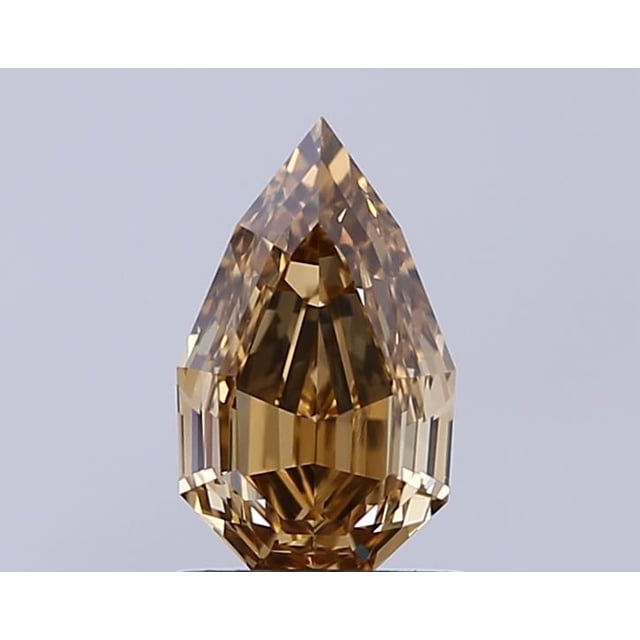
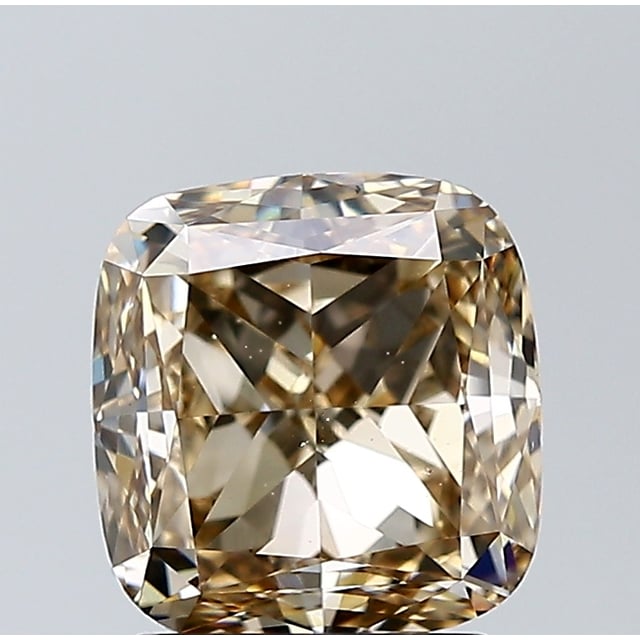
Facet style, not the color grade, decides how much of a warm tint you actually see. Two stones can carry the same GIA letter and the same brown notation and still look quite different across a table, because the cut determines whether body color is shown plainly or broken up.
Step cuts — emerald and asscher — return light in broad flat planes. Body color travels through long stretches of crystal and exits as an even wash, so a champagne stone reads clearly and consistently as champagne. Brilliant cuts — round, oval, pear, marquise, heart, cushion, radiant, princess — split returned light into many small flashes. That scattering dilutes the tint, and in elongated outlines it also concentrates what remains at the ends.
So there is no single best cut for a champagne diamond in the abstract. The question is whether you want the warmth stated or softened.
How the two facet families treat body color
Step cuts state it
A step cut is a series of long parallel facets cut in descending steps from the table down to the culet. There is little scintillation by design. Light enters, reflects off a small number of broad planes, and leaves. Because it passes through more uninterrupted crystal on the way, the tint has more opportunity to register, and because the facets are large, it registers evenly rather than in patches.
For a champagne stone this is the flattering treatment if you like the color. An emerald cut gives the most legible version of it: a warm, even field with a clean flash across the table. The asscher does the same in a square outline and tends to draw the eye toward a deeper center. Neither shape hides anything else either — clarity characteristics that a brilliant would fragment stay visible in an open table — so step cuts reward a stone that is clean as well as warm.
Brilliant cuts negotiate with it
Brilliant facets are triangular and kite-shaped, arranged to bounce light around inside the stone before releasing it. The effect on color is twofold.
The first is masking. A round brilliant returns so much light in so many directions that a Faint Brown K can read as a warm white in ordinary room light, with the tint surfacing mainly against a white background or in a low, even light source.
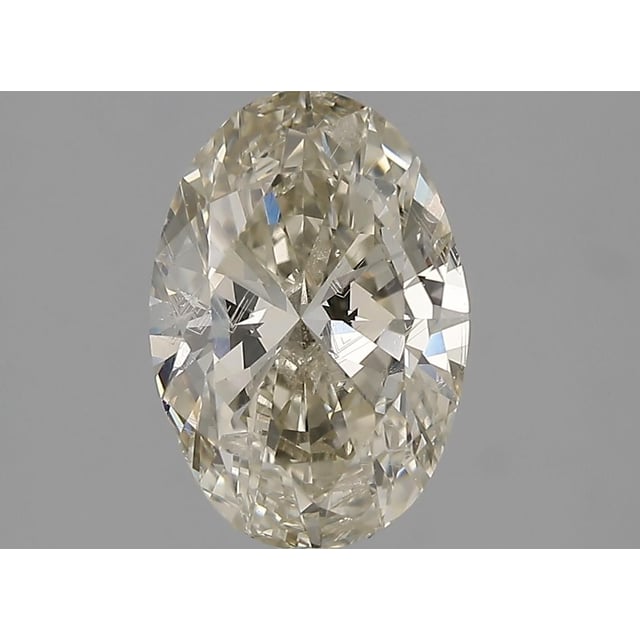
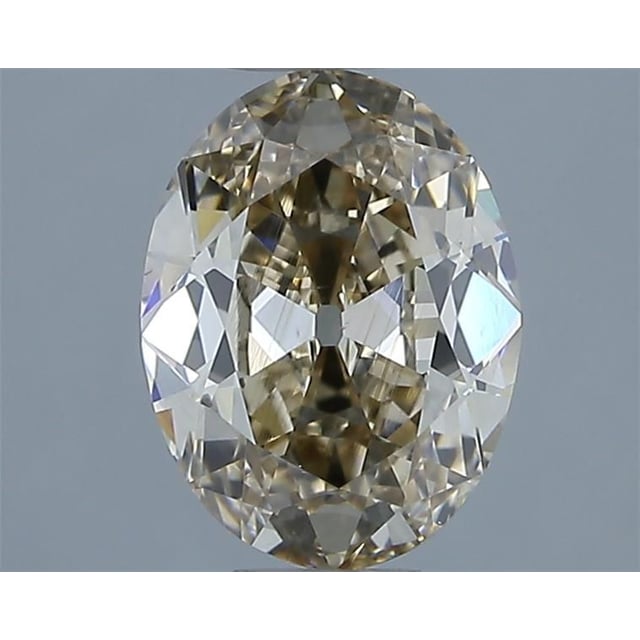
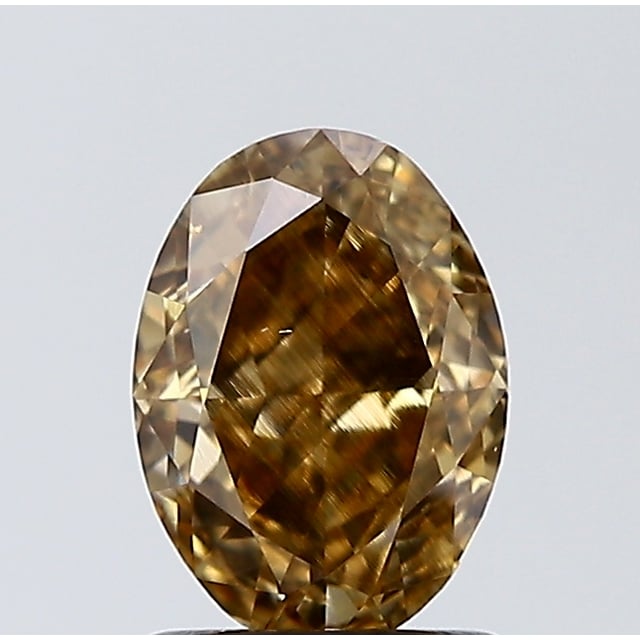
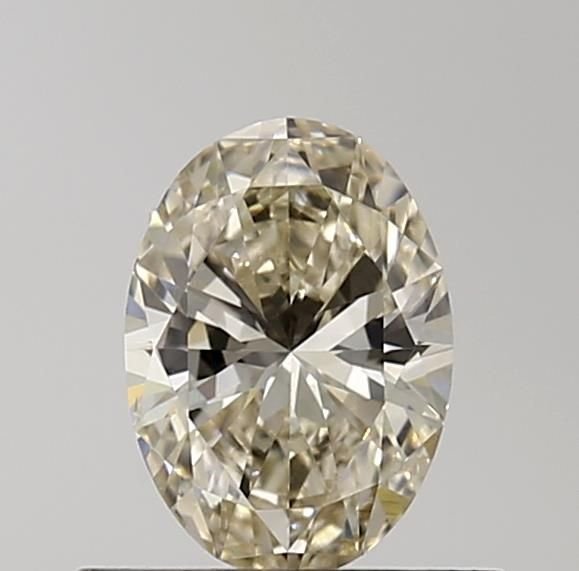
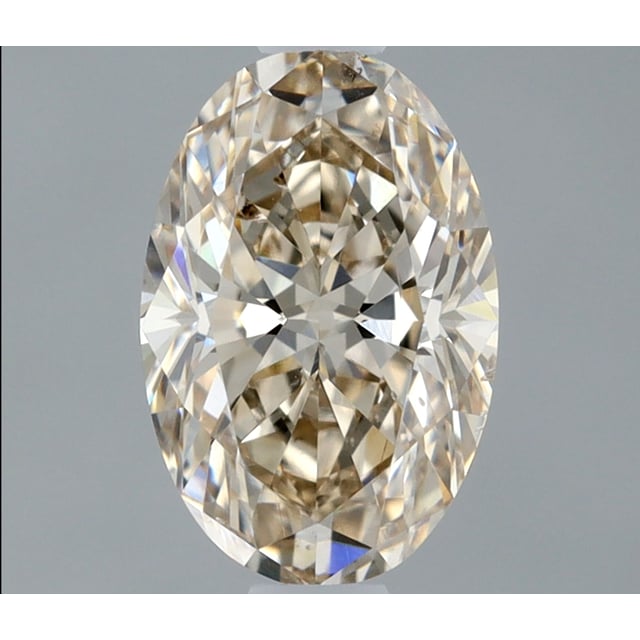
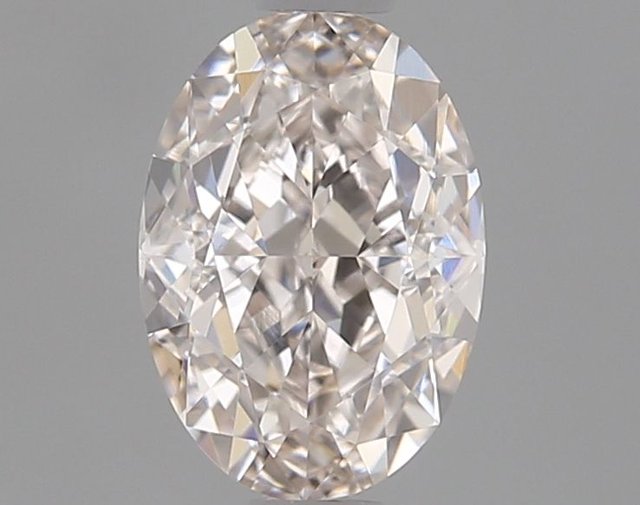
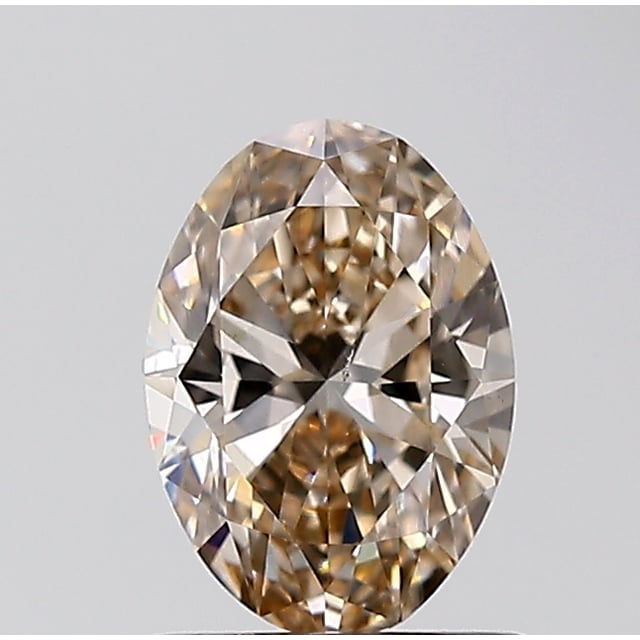
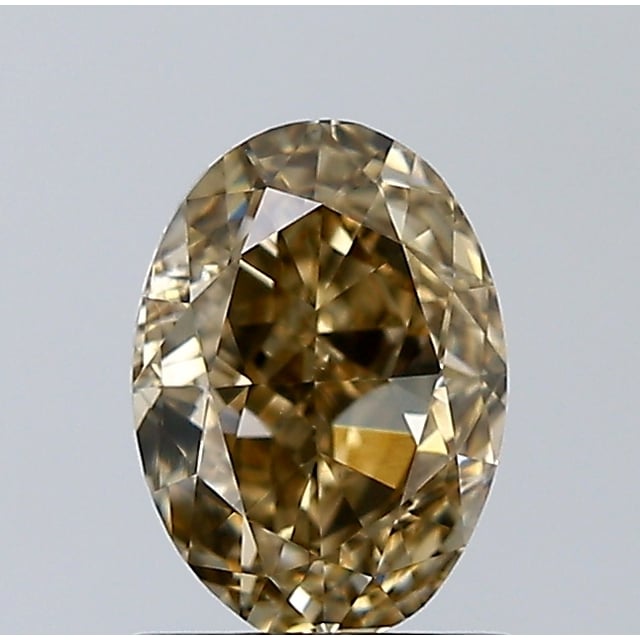
The second is pooling. Elongated brilliants have a long axis, and color gathers where the stone is deepest and where light has furthest to travel — usually the points. A pear often carries most of its visible tint in the tip, a marquise in both tips, and an oval across a soft band toward each end. Some buyers treat that as a fault to be avoided; others choose the shape precisely because the color reads as a gradient rather than a flat wash.
What the index actually holds
The 2,822 stones counted here come from nine retailers — Aurélinne, Blue Nile, Brilliance, Brilliant Earth, Leibish, Luvansh, Rare Carat, Ritani and With Clarity — and cover both kinds of brown the index tracks, white-scale stones graded with a letter and a brown notation and fancy-color stones whose dominant color is brown, a split explained in champagne vs fancy brown.
Counts and median prices by shape, on the 17 October 2026 build:
| Shape | Stones | Median price |
|---|---|---|
| Round | 1,452 | $1,069 |
| Pear | 358 | $1,917 |
| Oval | 334 | $1,437 |
| Cushion | 183 | $1,660 |
| Marquise | 119 | $1,529 |
| Heart | 114 | $1,321 |
| Emerald | 104 | $2,395 |
| Radiant | 81 | $1,551 |
| Asscher | 34 | $2,602 |
| Princess | 25 | $2,591 |
Round accounts for 1,452 of the 2,822 stones — more than every other shape put together. The practical consequence is that if you want a round, you can shop for the exact combination of letter, clarity and carat you have in mind. If you want a princess there are 25, and a handful of rarer outlines are represented by a single stone apiece, so the search is closer to waiting for the right one to appear.
Shape by shape
Which is the best cut for a champagne diamond depends on which of the two families you are after. Here is how each behaves, with the index figures alongside.
Round. The masking shape, and the cheapest on the index at a $1,069 median. Choose it when you want a stone that behaves like a white diamond in most light and shows its warmth only when you look for it. With 1,452 stones it is also the easiest shape in which to find any particular size. See round champagne diamonds for cut grade and fluorescence in this shape.
Oval and pear. The two largest non-round groups, at 334 and 358 stones. Both spread their weight along the long axis and both pool color toward the ends. A well-cut oval distributes it gently; a pear puts it in the point, which is either a signature or a distraction depending on how you feel about it. Medians run $1,437 and $1,917.
Marquise. 119 stones, $1,529 median. The most extreme elongation, so the most pronounced end-pooling — tint at both tips, brightest through the middle. It is the shape where the color pattern is most obviously part of the design.
Heart. 114 stones at a $1,321 median, the second cheapest on the index. The lobes and cleft break light up thoroughly, so a heart tends to mask a tint the way a round does, with a little concentration near the point.
Cushion. 183 stones at $1,660, close to the middle of the range. It is the fourth-largest group here, behind round, pear and oval. Larger, softer facets than a round; a cushion holds warmth in a way that many people read as candlelight rather than as a color grade. It sits between the two families in behavior.
Radiant and princess. Both are cut with brilliant faceting inside a rectilinear outline: 81 radiants at a $1,551 median and 25 princess stones at $2,591. They give the step-cut silhouette with brilliant-cut scatter, which is a useful compromise if you like the shape language of an emerald cut but want the tint softened.
Emerald and asscher. 104 and 34 stones, at $2,395 and $2,602. The shapes that show the color rather than argue with it — emerald cut champagne diamonds goes into what that does to clarity as well as color.
Why the step cuts cost more than round
Emerald at $2,395 and asscher at $2,602 sit well above the round median of $1,069, and above every brilliant-cut shape except princess. Two things are happening in that column, and only one of them is about the cut.
The first is scarcity. Emerald and asscher together account for 138 of the 2,822 stones on the index. A thin pool leaves less room for the discounting that a crowded pool produces.
The second, and larger, effect is size mix. The step-cut pools on this index skew large, and price climbs steeply with weight across the whole index — the median is $720 in the 0.50-0.99 ct band, $1,664 at 1.00-1.49 ct and $3,136 at 1.50-1.99 ct — so a shape whose stones are mostly above a carat will post a higher median even before any cut premium is counted. Set that against the gap between brown and untinted stones, covered in the pricing guide, and the shape figures above are best read as a description of what is on the shelf rather than as a tariff on facet style.