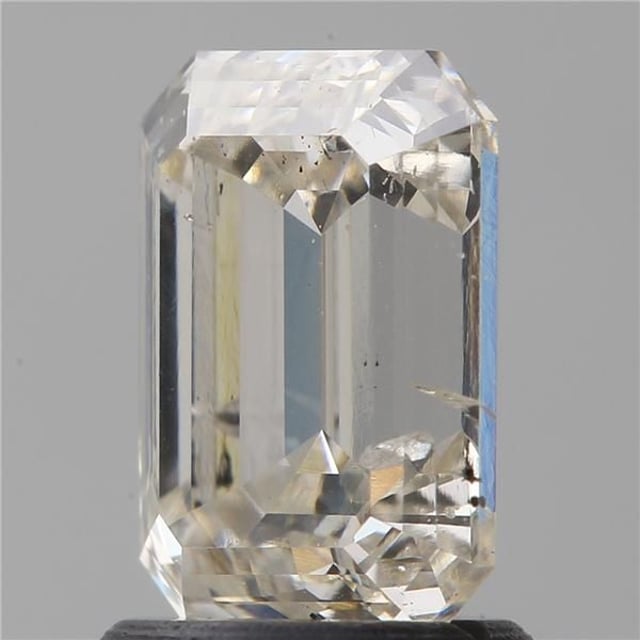
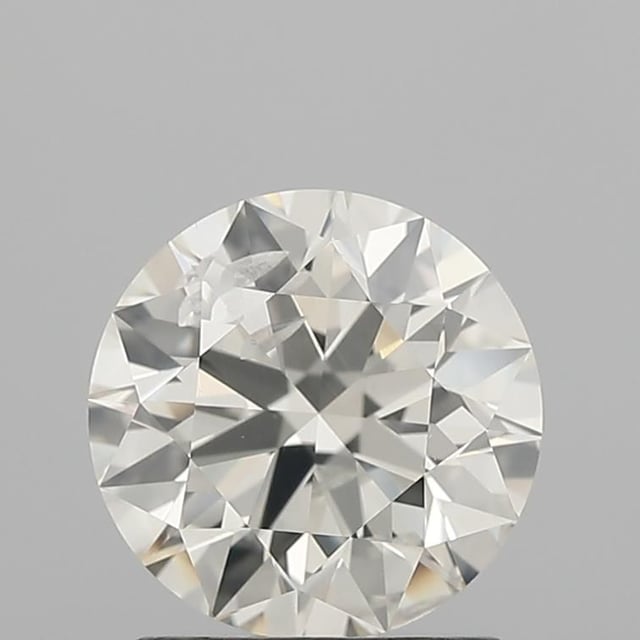
Clarity is graded on a champagne diamond exactly as it is on a colorless one, on the same eleven-grade scale, under the same 10x magnification, by the same laboratory. The tint changes nothing about the grade. What it does change is three practical things: graining, which shares an origin with the brown color; which GIA report a stone arrives with, because one of the colored-diamond reports carries no clarity grade at all; and nothing whatsoever about how visible an inclusion will be, despite a widespread belief that a warm stone hides more.
That last point is the one worth settling first, because it is the reason people ask about clarity on these stones in the first place.
The scale reads the same way
GIA bases clarity on the size, location, visibility and number of inclusions, examines every diamond at 10x magnification under controlled lighting, and assigns one of eleven grades.
| Grade | What GIA's definition says |
|---|---|
| FL | No inclusions and no surface characteristics visible at 10x |
| IF | No inclusions visible at 10x; surface characteristics only |
| VVS1, VVS2 | Inclusions so slight they are difficult for a skilled grader to see |
| VS1, VS2 | Inclusions observed with effort, but minor |
| SI1, SI2 | Inclusions are noticeable |
| I1, I2, I3 | Inclusions are obvious, and may affect transparency and brilliance |
GIA adds that most diamonds sold in jewelry stores fall between the VS and SI grades, and that many of the characteristics in that range are not visible to the unaided eye. Note what the grades describe: what a trained grader sees at ten times magnification, not what you will see across a dinner table.
That gap is where the trade phrase "eye-clean" lives. GIA defines it as an industry term for a diamond whose inclusions cannot be seen with the naked eye, and states plainly that GIA does not use the term. No grading report certifies a stone eye-clean, on any color of diamond; where a listing uses the phrase, it is the seller's judgment, made at a viewing distance and in lighting you cannot inspect.
Why the tint does no hiding
The brown in a natural champagne diamond is body color. GIA's Winter 2018 survey of naturally colored diamonds ascribes the color of the vast majority of brown stones to vacancy clusters — clusters of vacant carbon-atom positions — created through natural plastic deformation, the stone having been squeezed and sheared at depth over a very long time. That is a property of the crystal lattice throughout the stone, not a layer of color sitting between you and an inclusion.
What actually decides how much of an inclusion you see is the cutting style and the size of the face-up area. A round brilliant chops the returning light into dozens of small bright and dark facets, and a crystal or feather competes with all of that visual noise. A step cut gives you long parallel planes and comparatively calm light return, which is why an emerald cut champagne diamond asks more of the clarity grade, and why the same is true of the asscher in our guide to the two square cuts. Size works the same way in both directions: the larger the table you are looking through, the more there is to see. A grade that disappears at 0.70 ct can be visible at 2 ct.
None of that is champagne-specific. It is the ordinary mechanics of clarity, applying unchanged to a stone whose GIA report says Faint Brown beside the color letter.
Graining, the one characteristic tied to the color
There is a genuine connection between brown color and one clarity characteristic. The Winter 2018 research notes that brown and pink color is often associated with plastic deformation lamellae — graining, or slip planes — and that these are often visible as lines on the polished surface of the diamond, because the deformed planes polish at a different rate to the diamond around them. The process that made the color and the process that made the graining are the same process.
Graining can be recorded on a report, and it can also be invisible on the plot. GIA's own guidance on plotting diagrams says that some clarity characteristics are not plotted if they are widespread or faint, or if they are not needed to support the clarity grade or identify the diamond, and that they may be mentioned under Comments instead. Widespread and faint is a fair description of deformation graining in a brown stone.
The practical instruction is short: on a champagne diamond, read the Comments line, not only the diagram. A report that mentions internal graining has told you something the plot deliberately left out.
Whether you get a clarity grade at all
For most stones indexed here this question never arises. A D-to-Z stone with a brown notation goes through the standard diamond grading service and comes back with a clarity grade and a plotted diagram, alongside the color letter and hue notation.
Fancy-scale browns are different, because GIA offers three colored-diamond reports and they are not interchangeable. Checked on 26 September 2026, GIA's own comparison lists the Colored Diamond Grading Report and the Colored Diamond Origin Report as including both a clarity grade and a plotted clarity diagram, for loose stones of 0.15 carats and over. The third, the Colored Diamond Identification and Origin Report, accepts a diamond of any weight and includes neither: it addresses color and the origin of that color, and stops there.
So a Fancy Brown listing with no clarity specification is not necessarily an incomplete listing. It may be a stone whose report never carried one. Ask which report type the stone holds before you treat a missing clarity grade as a retailer oversight, and resolve the report number yourself — how we verify every stone sets out the checks that admit a stone to this index and how to run them.
What our index shows — data snapshot 25 September 2026, read on 26 September 2026
There were 2,803 unique verified natural brown diamonds live on the site, across 5,196 retailer listings at nine retailers, with 1,256 of those stones listed at more than one retailer at once. By GIA wording they are 2,271 Faint Brown, 349 Fancy Brown, 117 Very Light Brown, 52 Fancy Light Brown and 14 Light Brown, so the great majority sit on the lettered D-to-Z side, where a clarity grade and a plot are standard. The median asking price was $1,418, in a range from $70 to $594,710, and 2,473 stones were listed below our similar near-colorless benchmark, by a median of 46%. These are retailer asking prices on live listings, not records of completed sales.
What clarity does to the price comparison here
Clarity moves a diamond's price, and it moves the comparison figure with it. The struck-through price on every card is built from near-colorless G–H natural stones matched to the champagne stone on shape, on cut tier, on a carat window narrow enough that it never crosses a trade price threshold, and — at the first and strictest step of the match — on the same clarity grade, with no widening into an adjacent grade. The figure taken is the lower quartile of those matches rather than the median.
That matters when you are reading a large percentage. An SI2 stone is set against SI2 comparators, not against a cleaner white stone that would cost more and widen the gap. Where too few matches exist, the comparison falls back through looser steps, and every one of those steps admits only cheaper comparators, so a loose match can lower the struck-through price but never raise it. The two sides are both asking prices and a warm stone is never an exact substitute for a near-colorless one, so the figure describes the size of a gap rather than money saved. The method is on the prices page and in how our price benchmark works.
Checking clarity on a stone you are considering
- Read the clarity grade on the GIA report rather than the listing specification, then read the Key to Symbols. GIA lists the characteristics in order of importance to the grade, after any laser drill-hole, so the first entry is usually the one that set it.
- Read the Comments line for graining, and for anything the plot does not show.
- Ask for video of that individual stone, at the size you are buying, in ordinary lighting. Nothing about a grade tells you where the inclusion sits relative to the table.
- Weigh the grade against the cut. A step cut gives an inclusion room to be seen; a brilliant gives it competition.
- If the same report number appears at more than one retailer, compare those listings side by side — why the same stone carries different prices explains what usually differs, and it is rarely the diamond.
The collections are built on the GIA color wording rather than on clarity, so the shortest route into the stones themselves is by tint and shape: Faint Brown is the largest group by a wide margin, and round and emerald are the two shapes that show a clarity grade most differently.







