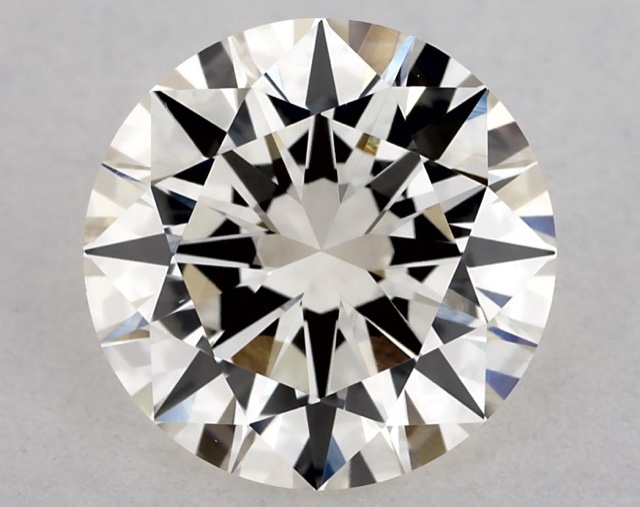
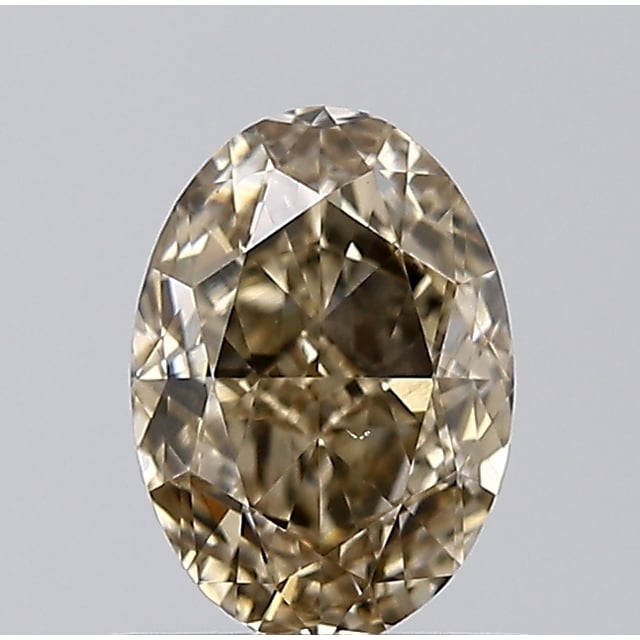
Every stone on this site carries two prices: what it is listed at, and what a near-colourless diamond matched to it is listed at. The second number is the benchmark, the gap between them is the discount printed on the card, and this guide is how that comparison is built — including where the method deliberately understates the gap.
On the 2026-10-04 data snapshot the index held 2,536 unique verified natural brown diamonds, deduplicated by GIA report number, across nine retailers. Of those, 2,274 are listed below their near-colourless benchmark, at a median discount of 47%.
What the benchmark stone is
The benchmark is not an average of the market, and not a formula applied to a rough carat price. It is a specific comparison: a near-colourless diamond matched to the brown stone on shape, clarity, cut and carat weight, so that colour is the only characteristic left to vary.
That matching is the point. A one-carat champagne cushion is compared to near-colourless cushions of the same clarity grade, cut quality and weight — the nearest thing to itself that differs only in tint. A stone shown at a 47% discount is listed at a little over half what that match is listed at, today, on the retailer's own page.
The comparator stones are G-to-H on GIA's standard D-to-Z scale, the upper half of the band GIA calls near-colourless. The D-to-F colourless band sits above it, but G-to-H is the range most engagement-ring diamonds are cut from, and the range the trade prices against day to day. Anchoring there measures the tinted stone against a mainstream white diamond rather than against a rarity.
Those comparators come from outside the index, because the index holds nothing above K — that is where brown notations live, so it has no white stones to compare with. G and H natural stones are pulled separately from one retailer's public listings, and only their price-relevant fields are kept: none is ever listed here, and no certificate is read for them, since the only question asked of a comparator is what it costs. A comparator is admitted only if its report is a GIA report, so the comparison is GIA against GIA throughout.
The rules that hold the match together
Five constraints decide whether a stone gets a benchmark figure and what that figure is.
Clarity is never widened at the strict step. The comparison runs against the same shape and the same clarity grade, and when the pool is widened later it is only ever towards lower clarity grades, never higher ones.
The carat window never crosses a trade threshold. Price per carat steps up at the weights the trade prices at — 0.30, 0.40, 0.50, 0.70, 0.90, 1.00, 1.20, 1.50, 2.00, 3.00, 4.00 and 5.00 carats — so a window straddling one of them would average two different markets. The window starts at 8% either side of the stone's weight, widens to 15% if that is too thin, and is clipped at any threshold it would otherwise reach over or under.
Cut is matched on the one scale every source shares. Retailers use their own cut vocabulary, so each label is mapped onto GIA's Excellent, Very Good and Good: Ideal, Super Ideal, True Hearts and similar house grades are Excellent stones with extra curation, and match against Excellent. That slightly understates what a Super Ideal stone saves, which is the safe direction to be wrong in.
Eight matches, minimum. No benchmark is shown unless at least eight matched listings exist at that step, so no struck-through price rests on one or two unusual stones.
The figure is the lower quartile, not the median. The matched listings are reduced to prices per carat, the lower quartile of that set is taken, and it is scaled to the stone's own weight. A buyer is comparing against the similar stone they could actually buy, and across several retailers that is near the floor of the range rather than the middle of it. Taking the median instead would raise benchmarks across the site and widen the discounts.
The strictness came from a correction. An earlier version, which let the carat window widen into the adjacent clarity grade, put the benchmark for a three-carat SI2 oval at about $36,100 while a near-colourless stone of that description was listed near $10,000 at an indexed retailer: the window had crossed the three-carat price cliff and pulled in cleaner stones from one retailer. Each rule above exists to keep that from recurring.
What our index shows, read 2026-10-05 on the 2026-10-04 data snapshot
2,536 unique verified natural brown stones, deduplicated by GIA report number, across 4,687 retailer listings at nine retailers. 2,274 are listed below their matched near-colourless G–H benchmark, at a median discount of 47%. Asking prices run from $92 to $593,280, with a median of $1,437. Each discount compares the stone with the closest near-colourless match the rules below allow, so what the gap prices is substantially the colour. All figures are retailer asking prices, not records of completed sales.
When an exact match does not exist
Thin shapes and unusual clarity grades do not always have eight near-colourless twins listed. Rather than leave those cards blank, the comparison steps outward in a fixed order: same clarity and cut; same clarity, any cut; one clarity grade lower, any cut; two grades lower or smaller carats, any cut; then any clarity or cut.
Every step admits only cheaper comparators — lower clarity grades, or a reach into the carat band below, never a higher grade and never a heavier band. So a looser match can lower a struck-through price and never raise it. Which step produced the figure is stored with the stone and shown on the card, with the carat window used and how many listings were matched, so the basis of a particular discount is visible rather than implied.
The strictest step also needs the stone's own cut grade to be known. Where a listing does not state one, the comparison falls to the next step, matched on clarity and carat but not on cut, and the card says so.
Why the tinted stone is usually cheaper
Colour is the reason, and it works differently on the two scales indexed here. On the standard D-to-Z scale, more colour means a lower grade, because that scale measures how little colour a diamond has: a K stone with a faint brown cast grades below a G and prices below it, and the brown notation moves the same way. This is where most of the index falls — 1,997 stones live on the snapshot are Faint Brown, the lightest of the three notations.
On GIA's separate fancy-colour scale, brown is the graded colour rather than an absence of one, and the fancy browns kept here still price below their near-colourless match. Part of that is by design: a fancy-scale stone is only admitted if it costs less per carat than the median untinted stone of its band. The two scales are set out in champagne vs fancy brown.
What the benchmark does not claim
It does not claim the two diamonds look alike. They do not: the whole reason one is cheaper is that its colour is visibly warmer, and whether that warmth suits you is a matter of taste and setting rather than of price. How a metal choice pushes a tint one way or the other is in champagne diamond engagement rings.
It does not claim the stone is a bargain in any investment sense. The benchmark compares two asking prices on one day, and says nothing about resale, about where prices go next, or about rarity.
And it does not rank stones. A 30% discount is not a worse diamond than a 55% discount; it is a less tinted one. To compare like with like you still read the grade, the cut and the clarity.
Reading it on a stone
The match is on four Cs, not one. Shape, clarity, cut and carat are held fixed wherever the listings allow it, and where a step has to loosen one of them the card says which. The prices page sets out how the matching runs across the index.
The grade is verified against GIA. Every diamond here carries a GIA report number that resolves in GIA's own lookup, and the colour on the card is the colour on the report — the method is in how we verify every stone. A discount is only as good as the grade it rests on.
Both sides are live asking prices. The benchmark moves as the near-colourless market does, and the stone's price moves as its retailer changes it. On the snapshot, 1,134 indexed stones were listed at more than one retailer at once — the one comparison here with nothing uncontrolled in it, worked through in why the same champagne diamond costs different amounts.
For the range the discount covers, browse the shallow end on Faint Brown and the fancy-graded end on Fancy Brown. What the tint is worth per carat, band by band, is in the champagne diamond price guide.







