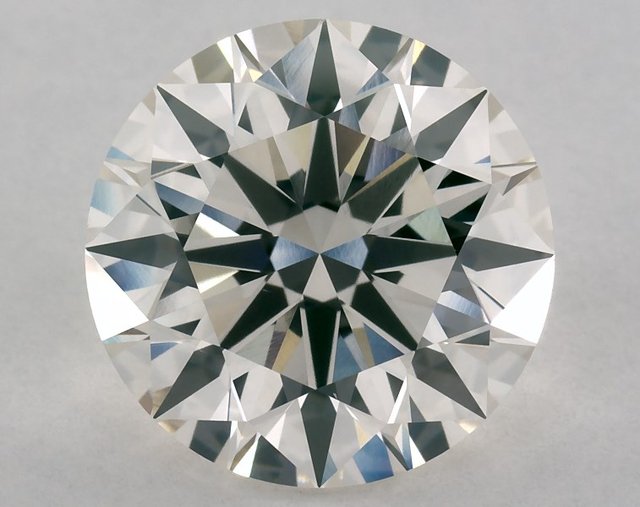
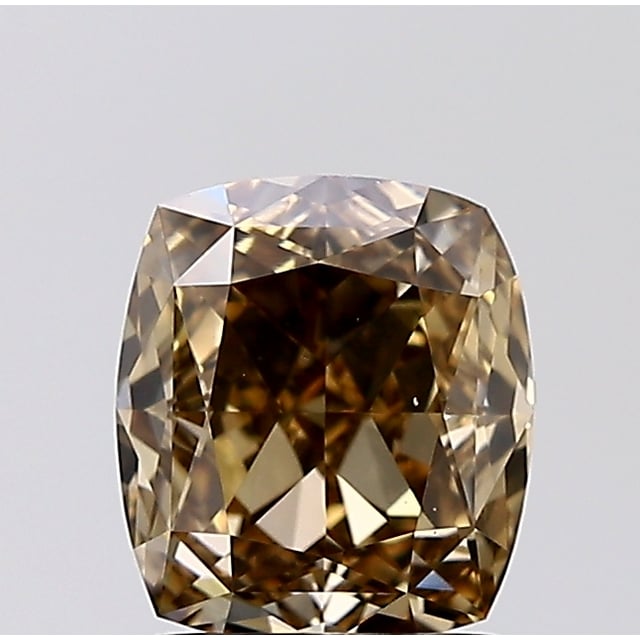
Both stones are diamonds that are not white, natural where the listing says so, and that is where the similarity ends. What separates them is which of the four Cs carries the thing you are buying, and whether a laboratory wrote it down. A champagne diamond is defined by color: GIA prints a brown notation beside a D-to-Z letter grade, or names brown as the dominant color on a colored-diamond report. A salt and pepper diamond is defined by clarity: dense dark and light inclusions, which GIA's scale ranks without describing. The pattern that makes one salt and pepper stone worth more to you than the next one is not on any grading report.
That difference decides everything downstream — what a listing can prove, whether two sellers can be compared on the same stone, and how a price is arrived at. This site indexes natural champagne diamonds and rings only, holds no stones of its own, and matches listings by GIA report number: 2,847 unique verified natural brown diamonds across 5,199 retailer listings at nine retailers on the 2026-10-15 data snapshot. Salt and pepper stones are not indexed here, and the comparison below is for readers deciding between the two before they shop.
Two descriptions, two scales
The champagne side sits on GIA's color line. Most of the index is white-scale material: a letter grade with a hue notation printed beside it, most often 2,292 stones at Faint Brown, then 134 Very Light Brown and 17 Light Brown. The rest is graded on the colored-diamond scale, where brown is the dominant color and there is no letter at all: 353 Fancy Brown and 51 Fancy Light Brown. What that notation is and where it prints is set out in what "Faint Brown" means.
The salt and pepper side sits on the clarity line, and the clarity line is a ranking rather than a description. GIA's scale has eleven grades, running from stones with nothing visible at 10× magnification down to I3, and the grade is set by the size, number, position, relief and nature of what a grader sees at 10× magnification. For the Included grades — I1, I2 and I3 — GIA's wording is that "inclusions are obvious which may affect transparency, brilliance and durability", and on its clarity chart that an I3 grade means "inclusions are obvious at 10X". None of that tells you whether the inclusions are scattered like pepper, banded, or pooled at one end. The phrase salt and pepper does not appear on GIA's clarity pages at all. It is a trade description, in the same way champagne is a trade description for a brown notation.
The two descriptions are not mutually exclusive, either. One ring in the rings section carries a maker's product name that combines both descriptions, a rose cut champagne salt and pepper diamond — a warm tint and a visible inclusion pattern in the same stone. A listing that uses both words is describing color and clarity at once, and the report, if there is one, is the only place to see how each was graded.
What the paperwork proves on each side
On the champagne side the documentation is standardized, and it is the reason this site can do what it does. Every stone indexed here has had its GIA report read and its color wording recorded, so that the brown notation — which retail color filters discard, because they are built on the letter alone — becomes a category you can browse. The verification method sets out exactly what is checked.
On the salt and pepper side, the documentation varies by seller, and what it covers is narrower than the thing being sold. The Antwerp dealer's 2.40 ct marquise checked on 15 October 2026 gives clarity as I2/3, says the stone was graded by the seller's in-house gemologist, and offers that "a certificate can be made upon request". In the 27-product salt and pepper ring collection checked the same day, listings are filterable by shape, carat weight and price, and not by whether a grading report exists. Neither of those is irregular for the category, and neither is hidden. It does mean the buyer is relying on photographs and on the seller's own grading for the characteristic that carries the stone's appeal.
Two practical consequences follow. First, a stone graded in house cannot be looked up independently, so the specification cannot be confirmed away from the page selling it. Second, matching breaks down: a one-of-a-kind included stone appears at one seller, under one description, so there is no second listing of the same diamond to price it against. On this index 1,214 stones were listed at more than one retailer at once on the 2026-10-15 snapshot — the same diamond, same report number, more than one asking price, which is the one comparison with nothing uncontrolled in it.
Price, stated carefully
Neither side is quoted in a form that makes a clean per-carat comparison honest, and the shapes of the two markets differ.
In the salt and pepper ring collection checked on 15 October 2026, listings ran from $158 for a 0.03 ct ring to $2,568 for a 2.50 ct pear, with the page's own price filter topping out at $4,216. The loose 2.40 ct marquise showed no price on its page. A finished ring includes metal, setting and a maker's labor; a loose stone does not, which is why the two cannot be laid side by side without the setting cost being counted — loose stone or finished ring covers that gap.
On the champagne side the loose figures are these: a median asking price of $1,420 across the index on the 2026-10-15 data snapshot, from $70 to $590,060. Each stone with enough matched comparators also carries a second price on its card, a near-colorless G–H diamond matched to it on shape, clarity, cut and carat weight, with the method on the prices page. That comparison is available precisely because the stones are graded on scales a comparator can be matched on. An inclusion pattern has no equivalent: there is nothing to match it against, so no benchmark of that kind can be built for a salt and pepper stone.
What our index shows — data snapshot 2026-10-15
2,847 unique verified natural brown diamonds, deduplicated by GIA report number, across 5,199 retailer listings at nine retailers, with 1,214 stones listed at more than one retailer. By GIA wording: 2,292 Faint Brown, 353 Fancy Brown, 134 Very Light Brown, 51 Fancy Light Brown, 17 Light Brown. Median asking price $1,420, range $70 to $590,060. 2,453 stones are listed below their matched near-colorless G–H benchmark, at a median discount of 45%. Asking prices on one snapshot, not completed sales.
Wear, and what to ask
GIA's own description of the Included grades names durability alongside transparency and brilliance, so the question to put to a seller is a practical one rather than a skeptical one: where do the largest inclusions sit, do any reach the surface or the girdle, and does the setting protect them. A bezel wraps the girdle in a continuous band of metal, which is one way a maker can answer that.
A champagne diamond is graded for clarity on the same eleven-grade scale, so the same question applies to a heavily included one of those; what moves with the tint rather than with the clarity is set out in champagne diamond clarity.
Which question you are answering
If you want a stone whose pattern is unrepeatable and chosen by eye, a salt and pepper diamond is that, and the trade-off is that you are buying the seller's description of the thing you came for. If you want a warm, even tone on a stone whose color, clarity and cut are written on a GIA report you can pull up yourself — and whose price can be set against both a matched near-colorless stone and, often, the same stone at another retailer — that is what the Faint Brown and Fancy Brown groups here hold. The two stones answer different questions, and only one of them is a question a grading report can help with.







