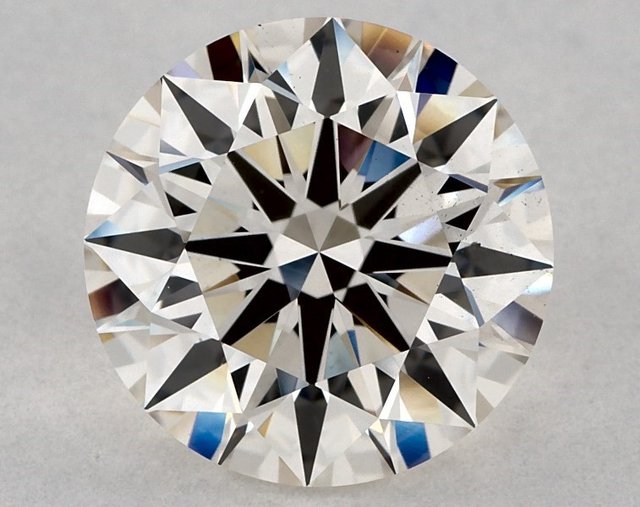
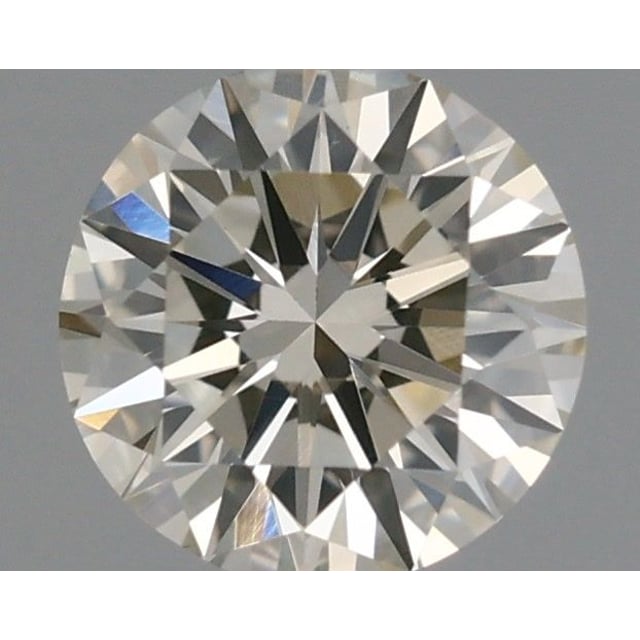
Fluorescence is worth reading on a champagne diamond, and it is not worth paying a premium for or demanding a discount over. GIA does not treat it as a grading factor at all: it is an identifying characteristic, printed beside polish and symmetry, and only about 25% to 35% of diamonds show any reaction to long-wave ultraviolet light. Champagne buyers hear otherwise because of a piece of trade lore — that blue fluorescence offsets a warm tint — and that lore does have a GIA study behind it. The study simply did not test brown stones.
That is the short answer. What follows is what the line on the report means, what the research actually measured and where it stops, what the haziness worry is worth, and why the struck-through prices on this site say nothing about fluorescence in either direction.
Champagne is a trade description rather than a laboratory term. A stone is admitted to this index only when GIA wrote a brown notation into the color grade line — Faint Brown, Very Light Brown or Light Brown beside a K-to-Z letter — or graded it on the colored-diamond scale with brown as the dominant color. How we verify every stone sets out both rules and how to resolve a single report number yourself.
What the fluorescence line on a GIA report says
Fluorescence sits in the additional grading information block on a GIA report, alongside polish and symmetry, and GIA lists those three together when it describes what that block contains. It is graded on a scale of five terms: None, Faint, Medium, Strong and Very Strong. From Medium upward the color of the reaction is named too, which is why a listing reads Strong Blue rather than Strong.
What the line records is a reaction to the concentrated long-wave ultraviolet radiation of a laboratory lamp. That is a deliberately severe test, not a description of how a stone behaves across a dinner table. GIA's own comment on appearance is specifically about natural daylight, which carries far more ultraviolet than most indoor lighting does.
Blue is the most common reaction of the ones GIA records.
Why champagne buyers are told it helps
The trade position is that blue fluorescence flatters a stone that already leans warm, and it is usually stated for the I-to-M stretch of the color scale. That band is where most of this index sits: the lettered stones here run K, L, M and N, which K, L, M and N color covers letter by letter.
GIA's wording on the effect is careful, and the second half of the sentence matters as much as the first: bluish fluorescence can make a faint yellowish diamond appear more colorless in natural daylight, but the color grade on a GIA report is not affected, because the grading environment is engineered for consistency.
So nothing on the report moves. A stone graded K Faint Brown with Strong Blue fluorescence is graded K Faint Brown, and it is priced against that grade by every retailer listing it. Fluorescence cannot soften a notation on paper. At most it changes what you see in one kind of light. What faint brown means covers how little of that notation is usually visible face-up to begin with.
What the research actually tested
The study behind all of this is Moses, Reinitz, Johnson, King and Shigley, published in GIA's Gems & Gemology in Winter 1997. Four sets of very similar round brilliant diamonds were assembled, covering the color range from colorless to faint yellow and chosen to represent the commonly encountered strengths of blue fluorescence. Trained graders, trade professionals and members of the public then observed them in different stone positions and lighting environments.
Four findings are worth carrying to a purchase:
- For the average observer, taken to represent the buying public, no systematic effects of fluorescence were detected.
- Even experienced observers did not consistently agree on the effects from one stone to the next.
- Strongly blue fluorescent diamonds were generally perceived to have a better color appearance viewed table-up, with no discernible trend table-down.
- Most observers saw no relationship between fluorescence and transparency.
Now the limit. The range tested ran from colorless to faint yellow. Brown-notation stones were not the subject, and neither were fancy-scale browns. Blue set against yellow is the comparison that study makes, and a brown notation is a different description of a different hue. Treating the result as a promise about a champagne diamond is an extrapolation, and this site would rather name it as one than repeat it as a finding. If the effect holds on brown stones, it has not been published in the form a buyer could rely on.
The haziness worry, in proportion
The counter-lore is that Strong and Very Strong fluorescence makes a diamond look hazy or oily. GIA's position is that fluorescence does not cause haziness by itself, and that where the hazy effect does appear it occurs in fewer than 0.2% of the fluorescent diamonds submitted to GIA.
That makes it a question about one stone rather than a reason to filter out a whole strength. If a stone you like reads Strong or Very Strong, ask the retailer for video shot in daylight rather than under studio lights, and read the return window before you pay. On a warm stone this is slightly more useful advice than on a colorless one, because what you are judging is how the diamond reads rather than the absence of anything.
What our index shows — data snapshot 23 September 2026, checked 24 September 2026
There were 2,796 unique verified natural brown diamonds live on the site, across 5,166 retailer listings at nine retailers, with 1,232 of those stones listed at more than one retailer at once. The median asking price was $1,426, with a range of $70 to $594,710. Depth of tint was overwhelmingly the faintest grade: 2,265 Faint Brown, against 117 Very Light Brown and 15 Light Brown on the white scale. None of those counts is split by fluorescence, for the reason set out below. Prices here are retailer asking prices on live listings, not records of completed sales.
What fluorescence does to the prices on this site
Nothing, and that is the point worth knowing before you read a percentage off a card.
The struck-through figure on every stone compares it with a similar near-colorless G–H diamond matched on shape, on the same clarity grade, on the same cut grade, and within a carat window narrow enough that it never crosses a trade price threshold; the figure taken is the lower quartile of those matches. Fluorescence is not one of the matched variables, and the site says so in its own explainer on those price chips. How our price benchmark works sets out the full method, and the prices page carries the build's current figures.
The consequence is specific. On a stone with Strong Blue fluorescence, the comparison set is near-colorless stones of mixed fluorescence, so the percentage measures the price of the tint and the letter. It does not measure a fluorescence premium or a fluorescence discount, and reading it as one would be a mistake in either direction.
There is also no champagne-specific fluorescence price effect published here, because the data to support one does not exist yet. It would take matched sets of stones holding letter, brown notation, carat band, clarity and cut fixed and varying only fluorescence — and fluorescence is not published on every listing indexed here, so those sets would have to be built from the reports rather than from the listing pages.
How to check it before you buy
- Read the fluorescence line on the GIA report rather than the listing specification, since a listing may omit it and an omission is a gap in the listing, not a grade of None.
- Resolve the report number in GIA's own Report Check before you treat any specification as settled.
- If the line reads Strong or Very Strong, ask for daylight video of that stone specifically.
- Do not pay more for None, and do not expect a store to discount Strong Blue. Neither position is supported by evidence covering brown stones.
Fluorescence is a tiebreaker between two stones you already like. Carat weight, the color letter, the brown notation and the cut grade do nearly all the work on both appearance and price, which is why the round collection and the guide to round champagne diamonds spend their time on cut grade rather than on the fluorescence line. Read it, understand what it is not telling you, and spend the attention elsewhere.







