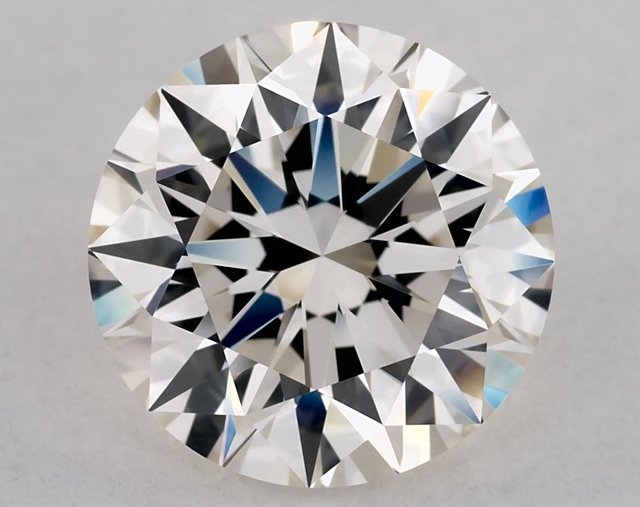
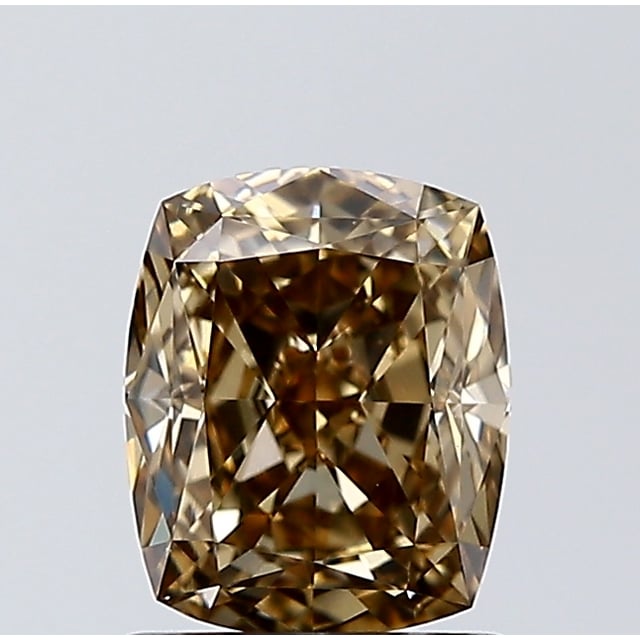
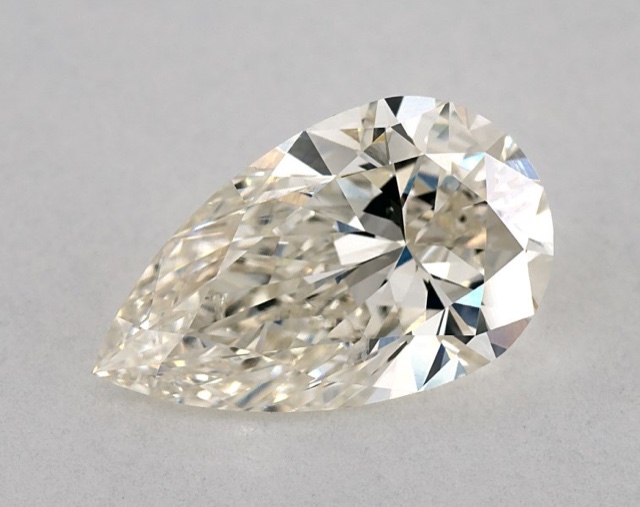
A champagne moissanite and a champagne diamond are not two grades of the same thing. Moissanite is silicon carbide, grown in a laboratory in essentially every stone sold for jewelry, and its warm tone is produced during growth. A champagne diamond is a natural diamond whose brown tint GIA wrote onto a grading report. This site indexes natural champagne diamonds and rings only; it lists no moissanite, and the comparison below is for readers deciding between the two before they shop.
The price assumption is the part most people have backwards. At Brilliant Earth, one of the nine retailers this index tracks for natural stones, the 8 mm champagne round moissanite was listed at $1,250 when we checked on 14 October 2026. On the 2026-10-14 data snapshot, the median asking price across the 2,814 natural champagne diamonds indexed here was $1,428. At that retailer, in that size, the moissanite is not the budget option — it costs roughly what a mid-priced natural champagne diamond costs. What the extra millimeters buy, and what the grading report buys, are different things, and that is the real decision.
Two different minerals
The Federal Trade Commission's Jewelry Guides define a diamond as a mineral consisting essentially of pure carbon crystallized in the isometric system, with a hardness of 10, a specific gravity of about 3.52 and a refractive index of 2.42. The same section treats the unqualified word diamond as deceptive for any product that does not meet that definition.
Moissanite meets none of it. GIA's own measurements, published when the material reached the jewelry trade, put its refractive indices at 2.648 and 2.691, its dispersion at 0.104, its hardness at 9¼ on the Mohs scale and its specific gravity at 3.22. GIA classes it as a simulant — a material that looks like another gem and substitutes for it while having a different chemical composition, crystal structure and optical and physical properties. Natural moissanite exists, first identified in a meteorite, but Brilliant Earth's own gemstone page puts the trade position plainly: all moissanite used in jewelry is grown in laboratories.
Three of those numbers matter at the counter. The hardness of 9¼ is high, and below diamond's 10. The dispersion of 0.104 is why GIA describes moissanite as having more than twice the fire of diamond, and why it throws stronger flashes of color as stones get larger. And a specific gravity of 3.22 against roughly 3.52 means a moissanite cut to the same dimensions as a diamond weighs around eight percent less — which is why sellers quote millimeters. The listing above is an 8.0 x 8.0 mm round, sized rather than weighed.
Where the champagne color comes from
On a natural champagne diamond, the color is a property of the stone that a laboratory grades and records. On the white scale it appears as a brown notation printed beside an ordinary letter — Faint Brown, Very Light Brown, Light Brown — and what faint brown means covers how that line is written. On GIA's separate fancy-color scale, brown is named as the dominant color and no letter is given. Either way the wording comes off a report, which is why Faint Brown and Fancy Brown can be browsed here as separate categories.
A moissanite's color is a product specification, and the vocabulary is the seller's. The Brilliant Earth stone is sold as a champagne moissanite, and its color description on the same page reads "Medium Yellowish Orange". Neither phrase is a laboratory grade, and the second is not even brown. That is not concealment — it is what naming looks like when there is no grading scale behind it. On a natural stone the equivalent line is a color grade GIA assigned, and the wording is fixed by the laboratory rather than by the shop.
What you can verify, and what you cannot
Every stone on this index carries a GIA report number that resolves in GIA's own lookup, and the color on the card is the color on the report; the two rules that admit a stone are set out in how we verify every stone. A moissanite has no equivalent. GIA grades diamonds on the D-to-Z and fancy-color scales; a moissanite submitted to a laboratory is identified as the material it is, not graded against either scale. The Brilliant Earth listing names no report number, and says its gemstones are hand-selected by GIA-certified gemologists — a statement about the seller's staff rather than a document about the stone.
Identification is also where the folklore is wrong. GIA's 1997 research found moissanite's thermal properties so close to diamond's that the thermal probes then on the market read it as diamond, and a separate moissanite tester had to be built. The reliable check is optical. Moissanite is doubly refractive, so a viewer sees a double image of its back facets, and doubled facet junctions remain the standard separation. If you are buying a warm-toned stone secondhand or without paperwork, that is the test to ask for — and a champagne diamond with no grading report covers what else is left open.
What our index shows — data snapshot 2026-10-14
2,814 unique verified natural brown diamonds, deduplicated by GIA report number, across 5,129 retailer listings at nine retailers, with 1,219 stones listed at more than one retailer at once. By GIA wording: 2,269 Faint Brown, 134 Very Light Brown, 17 Light Brown, 344 Fancy Brown, 50 Fancy Light Brown. Median asking price $1,428, range $92 to $590,060. 2,420 stones are listed below their matched near-colorless G–H benchmark, at a median discount of 45%. Retailer asking prices on one snapshot, not records of completed sales. No moissanite is indexed here.
What the two cost, stated carefully
Brilliant Earth's loose moissanite ran from $325 for a 5 mm round to $3,490 for a 12 x 10 mm radiant on 14 October 2026, with the champagne round at $1,250. Prices and stock at any retailer change without notice, and that single listing is not the whole moissanite market: smaller sellers and marketplaces advertise champagne moissanite for far less, and we have not verified those prices.
Against that, the natural side of the comparison. Half the stones indexed here are listed at $1,428 or less, and the range runs from $92 to $590,060, so budget is not the dividing line between the two materials — size at a given budget is. An 8 mm moissanite is a large-looking center stone for $1,250. A natural champagne diamond at the same money is a smaller stone, and what it carries instead is a grade, a report number and a price you can test two ways: against a matched near-colorless stone, the method set out in how our price benchmark works and on the prices page, and against other retailers listing the identical stone — 1,219 of the stones here were listed at more than one retailer on the snapshot. Neither test exists for a moissanite, because moissanite is manufactured to a size rather than identified as an individual stone, so there is no report number by which two listings can be matched.
How a listing should read
The disclosure rules are worth knowing because they tell you what a straight listing looks like. For a stone that was not mined, the FTC's Jewelry Guides require the gemstone name to be immediately preceded, with equal conspicuousness, by laboratory-grown, laboratory-created, a manufacturer-created wording or a phrase of like meaning, or by the word imitation or simulated — and the guides state specifically that faux is not an adequate disclosure. The Brilliant Earth listing marks the stone as lab grown on the product page, which is the rule working as intended.
Two things to treat as questions rather than conclusions: a warm-toned stone described only as champagne, with no material named anywhere on the page, and any use of the word diamond for a stone that is not carbon. The second is the line 16 CFR 23.12 draws.
Which question you are actually answering
If you want the largest, brightest warm-toned center stone a few hundred to a couple of thousand dollars will buy, and the material matters less to you than the look, a moissanite does that, and the fire will be stronger than a diamond's. If you want a natural stone whose color a laboratory graded and whose price you can check against both a near-colorless comparison and other sellers of the same stone, that is what this index is built for: start with round champagne diamonds, the deepest pool here at 1,468 stones, or compare finished champagne diamond rings. The parallel decision against a laboratory-grown white diamond is worked through in lab-grown white diamond or natural champagne, and what the tint is and is not is in what is a champagne diamond.







