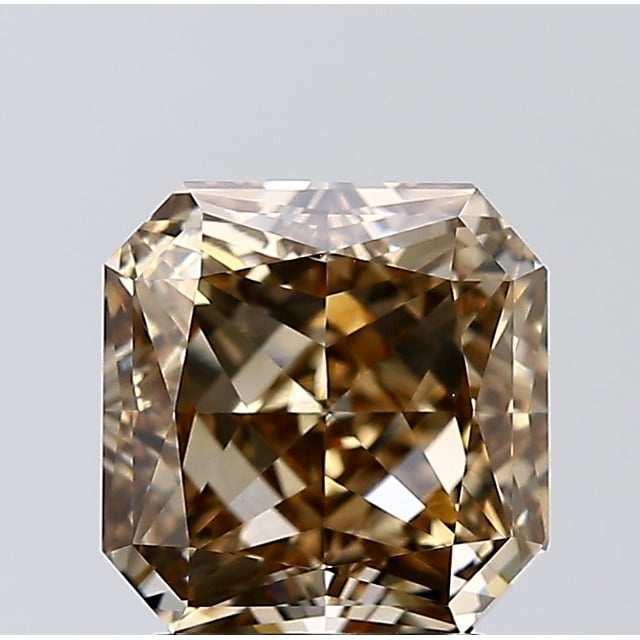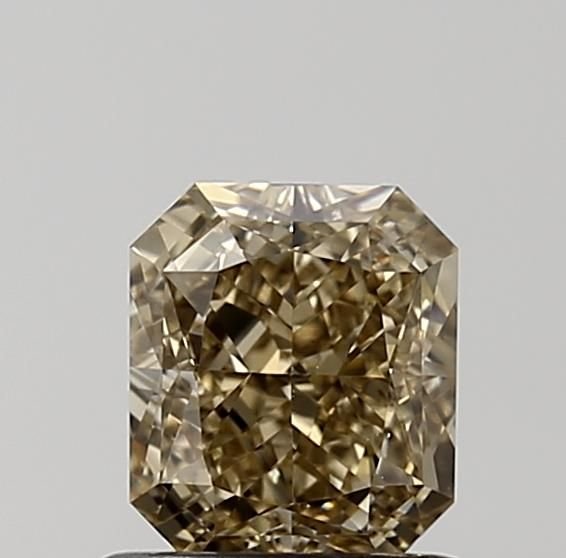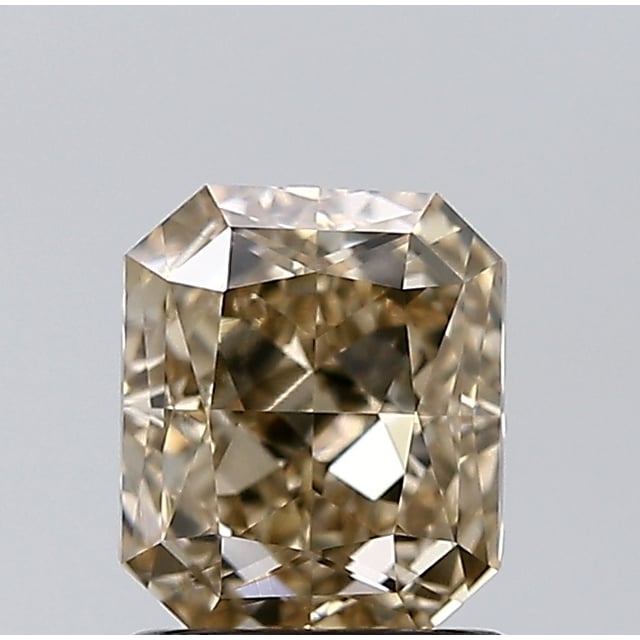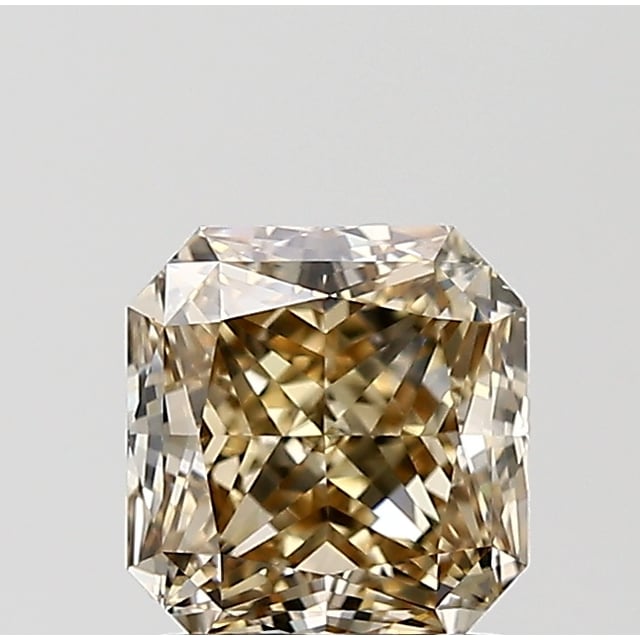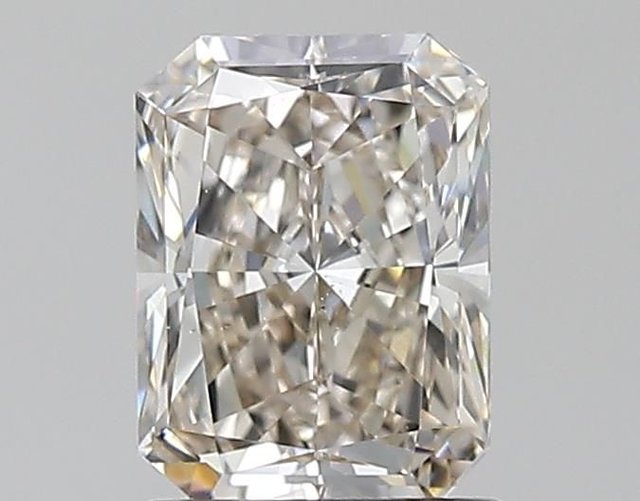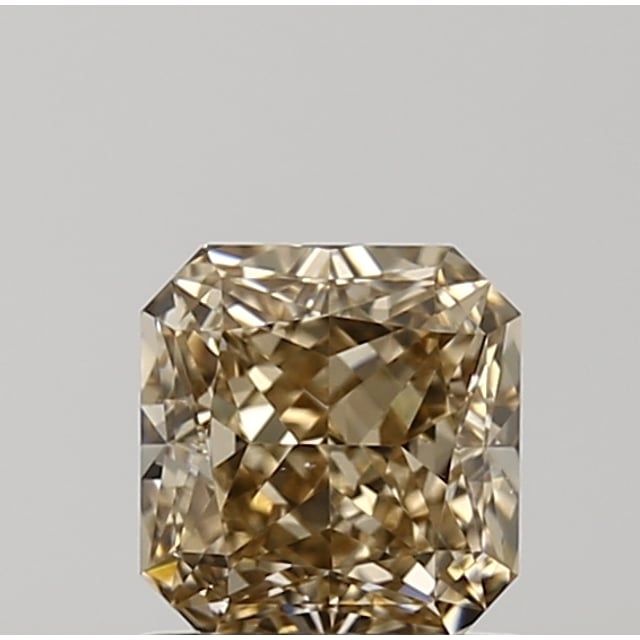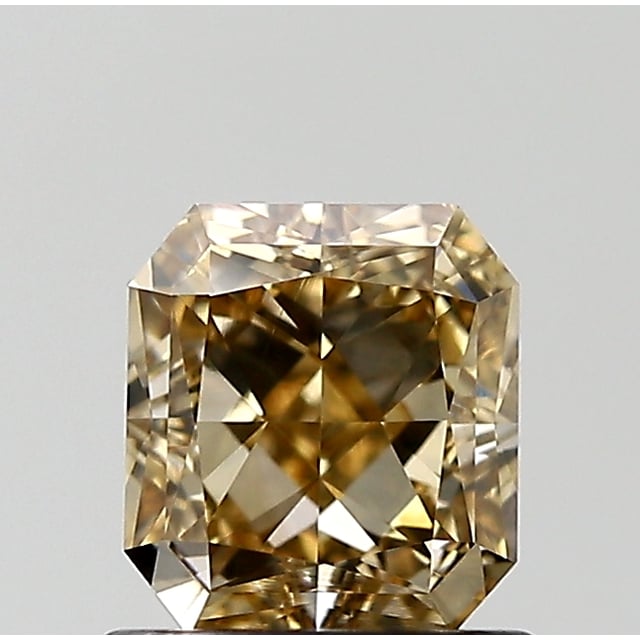
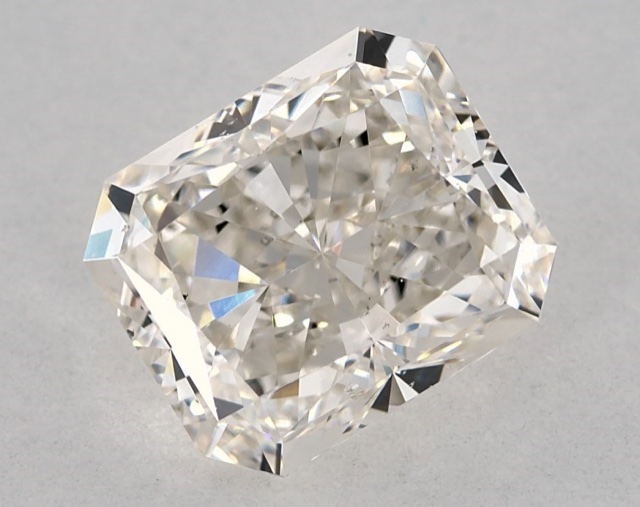
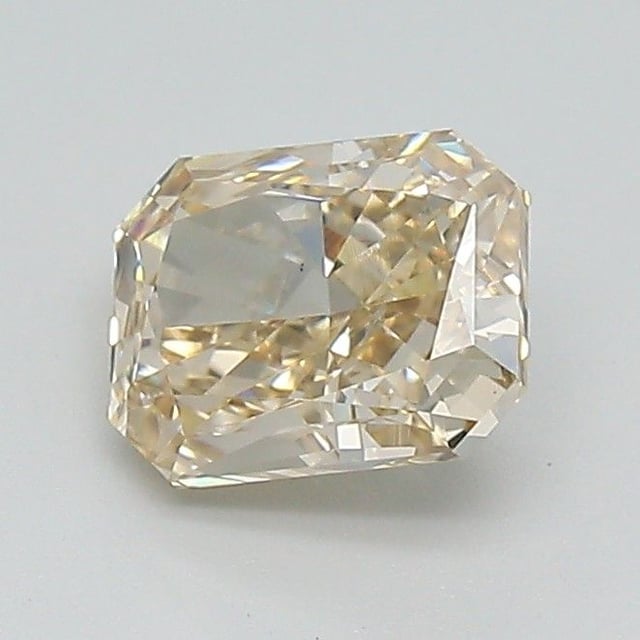
Every other shape guide on this site asks how much of the tint the faceting hides. A radiant cut champagne diamond inverts the question, because the radiant is the one common outline the trade uses to make body color read more strongly rather than less. GIA puts it plainly: colored diamonds are usually cut to maximize the intensity of their color rather than to maximize light return, and cutters discovered that certain styles, typically mixed cuts like the radiant, can intensify color in diamonds toward the lower end of the D-to-Z scale. If you want the warmth to be the point of the stone, this is the outline built for it. If you want a barely-there tint, it is the outline most likely to overshoot.
That is the practical answer. The rest covers what a radiant is, how far GIA's evidence reaches, what the radiants here look like as a group, and the checks that separate a good one from a poor one. You can browse every radiant cut champagne diamond indexed here while you read; there were 76 of them on the 2026-09-18 data snapshot.
Champagne is a trade description, not a laboratory term. A stone is admitted here only when GIA wrote a brown notation into the color grade line — Faint Brown, Very Light Brown or Light Brown beside a K-to-Z letter — or graded it on the colored-diamond scale with brown as the dominant color, as in Fancy Brown. How we verify every stone sets out both rules and how to check a single diamond against its own report.
What a radiant actually is
A radiant has an eight-sided outline, typically square or rectangular with cut corners, and it is a hybrid: step cut facets on the crown, brilliant cut facets on the pavilion. That combination is the whole design. Henry Grossbard patented the style in the late 1970s, and others have cut it freely since the patent expired, which is why radiants from different cutters vary more than rounds do.
The hybrid sits between the two shapes buyers compare it with. An emerald cut is a step cut top to bottom: broad parallel planes that show body color evenly and openly. A round brilliant scatters light into many small flashes, and that scattering dilutes color. A radiant borrows the emerald's silhouette and the brilliant's pavilion, so it keeps more of the color than a round while still flashing rather than showing flat planes.
One consequence is mechanical rather than optical, and explains why the shape is common in tinted material: GIA notes that the radiant style provides higher yield from the rough than a standard round brilliant. Brown rough that would lose too much weight as a round survives better as a radiant.
How far the evidence reaches
GIA's statements about radiants and color are specific, and it is worth being exact about what they cover.
The laboratory says the radiant has the ability to transform a diamond's color appearance, making the color appear either lighter or darker when viewed from above, and that a colored diamond is sometimes recut into a radiant to improve its face-up color. GIA's own illustration is a yellow stone: a round brilliant of just over 6 carats, graded in the W-X range of the D-to-Z scale, recut to a 4.61 carat radiant and subsequently graded Fancy yellow. GIA adds that many stones once called cape by the trade can become fancy yellows face-up when carefully fashioned as radiants.
Two qualifications follow. The documented examples are yellow, not brown; GIA has not published an equivalent brown study that we can cite, and the honest position is that the effect is a property of the cutting style rather than a graded promise about any individual stone. And the effect runs both directions — lighter or darker — so a radiant is not a guarantee of more visible warmth. What it removes is the assumption, safe in a round, that the faceting will mute whatever the report records. What "faint brown" means covers how little of that notation usually shows face-up, and the radiant is the shape where that generalization is least reliable.
What this index shows about radiants
The composition of the radiants here is consistent with a cut used where color is the product rather than the problem.
Of the 76 radiants live on the 2026-09-18 snapshot, 49 carried a photograph on the index. Those 49 split 43 to six in favor of the colored-diamond scale: 38 Fancy Brown and five Fancy Light Brown, against five Faint Brown and one Very Light Brown. Site-wide the ratio runs the other way, and heavily — 2,170 Faint Brown against 322 Fancy Brown among the 2,673 unique stones indexed on that snapshot, with 373 stones fancy-scale in total once Fancy Light Brown's 51 are added.
Read that as an indication rather than a measurement: 49 is the photographed subset of one shape, 2,673 is every live stone regardless of imagery, and what a retailer photographs is its own decision. The direction still matches what the cut is for, and rounds here run the opposite way. Best shapes for champagne diamonds compares all of them on the same data.
Reading a specific radiant
GIA issues a cut grade for round brilliants only, so any cut label on a radiant listing is the retailer's own judgment rather than a laboratory grade. A fancy-shape report carries polish and symmetry, which describe finish and outline rather than light return. That leaves the work to your eyes, and GIA's own advice for the shape is a short list:
- The corners. Avoid corners that are uneven, either too wide or too narrow. The four cut corners are the shape's signature and the first place a rushed cut shows.
- The culet. It should sit centered. An off-center culet drags the whole pattern out of alignment.
- The sides. They should run parallel. A radiant that tapers slightly reads as a trapezoid once it is set.
Two further checks matter specifically for a tinted stone. The first is faceting pattern: radiants, like cushions, are cut anywhere between crushed ice, a fine mosaic of small flashes, and chunky, fewer and larger facets. Chunky faceting holds warmth in broader pools that the eye reads as color; crushed ice breaks it into small scattered points. Neither is graded and neither is better, but they present the same grade very differently, and the trade terms are descriptions rather than defined categories.
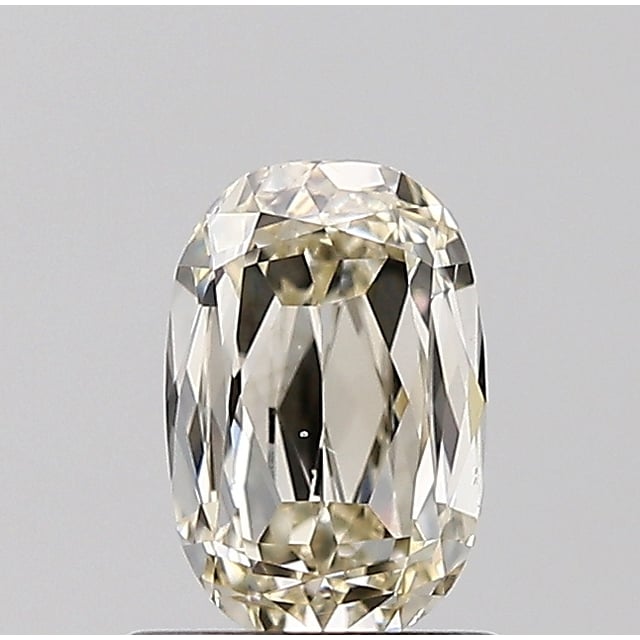
The second is ratio. Radiants run from square to distinctly elongated. Ratio is taste rather than quality and is not graded, but it changes face-up size, so read the millimeter measurements on the listing instead of inferring size from carat weight, and watch an elongated radiant for a bow-tie — the dark band across the width that appears in stretched brilliant pavilions — in the middle third of the stone on full-screen video.
On clarity, the radiant is the more relaxed of the two square outlines: GIA notes that unlike the emerald cut, which favors diamonds of exceptional clarity, a radiant can be more forgiving of inclusions, because brilliant pavilion facets break up the view a step cut gives straight through the stone.
What a radiant cut champagne diamond costs
Carat weight sets the price first and the tint second, and today's snapshot supports no radiant-only median. Read the radiant collection against your carat band, with champagne diamond prices for the band structure across every shape and one carat and over for the band most buyers land in.
Two comparisons frame what the tint is worth here, and they measure different things. Every card is priced against a similar near-colorless G–H natural diamond matched on shape, clarity, cut tier and carat weight, taken at the lower quartile of current listings; stones with a saving run a median 44 percent below that benchmark. That compares asking prices rather than completed sales, and a warm radiant and a near-colorless one are never a perfect match, so the figure describes the size of a gap. The method is on the prices page and in how our benchmark works. The second comparison is about one stone rather than two: because these listings come from nine retailers and are matched by GIA report number, the same diamond is often listed by more than one store at different asking prices, which why the same champagne diamond costs different amounts explains.