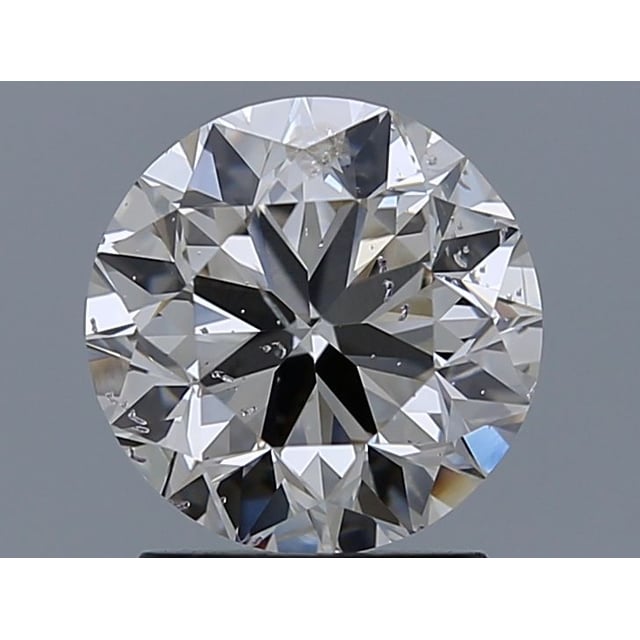
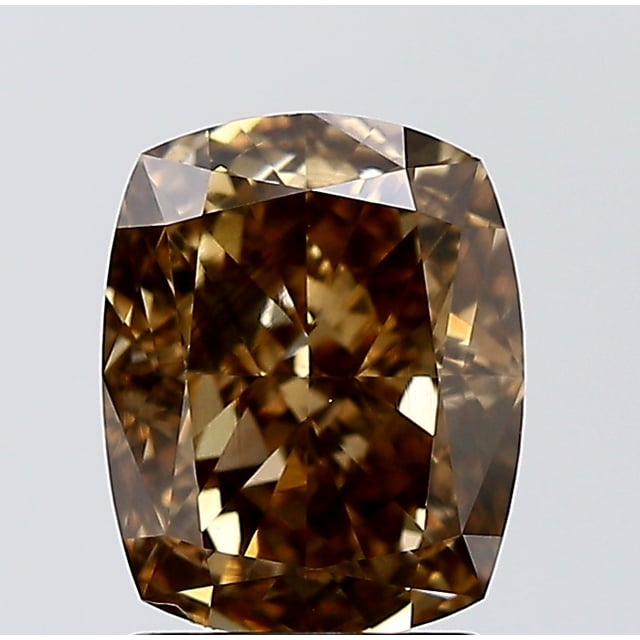
There is no single champagne diamond color chart, and the one most searches land on cannot be verified against a grading report. The C1-to-C7 scale came from a single mine in Western Australia. It is a producer and trade scale rather than a laboratory one, no GIA report carries a C number, and the published versions of the chart disagree with each other about where champagne ends and cognac begins. A seller who writes C4 is describing how dark the stone looks to them.
That is the short answer. What follows is where the scale came from, what three currently published charts actually say when you put them side by side, the wording GIA prints instead, and how to turn a listing that says C4 into something you can check yourself.
Where the C scale came from
The Argyle mine in Western Australia produced diamonds for 37 years, and Rio Tinto's own page on the operation lists what came out of it: white, yellow, brown, blue, violet, and the pink and red stones the mine became known for. Brown was ordinary there in a way it is nowhere else in the trade, and a mine selling that much brown material needed vocabulary for it.
Writing for The Diamond Collective in April 2026, Jill Newman records what Argyle built: a classification system to separate the subtle shade variations, running from C1, light champagne tones, to C7 or C8, deep cognac and chocolate hues. Brown diamonds, in her account, are judged on tone, saturation and secondary hues rather than on how close they come to colorless — a reasonable way to sort brown material, and a different exercise from grading a diamond against master stones.
Two facts about that origin matter to a buyer today. The scale was proprietary to one producer, so no laboratory adopted it. And Rio Tinto states that mining ceased at Argyle in November 2020, so nobody has been applying the scale at source for nearly six years. What circulates now are secondhand versions of it, which is why they have drifted apart. How the names champagne, cognac and chocolate arrived in the first place is the subject of our piece on four decades of renaming the same diamond.
Three published charts, three different boundaries
Here are three descriptions of the same seven numbers, all live and all reputable, read on 25 September 2026.
| Published chart | The bands it gives | Where cognac begins |
|---|---|---|
| The Diamond Pro, updated 30 March 2026 | C1–C2 light champagne, C3–C4 medium champagne, C5–C6 dark champagne, C7 cognac | C7 |
| International Gem Society, updated 16 May 2023 | C1 lightest, C2–C3 true champagne, C4–C7 cognac | C4 |
| The Diamond Collective, 10 April 2026 | C1 light champagne tones through to C7 or C8, deep cognac and chocolate hues | Not given as a number |
Read the middle of that table slowly. A stone described as C4 is medium champagne on the first chart and cognac on the second. Both guides are describing the Argyle scale in good faith; they simply place the cut differently. Three charts also give the scale three different ceilings: C7 in one, C7 or C8 in another.
So two sellers can each call a stone C4, mean genuinely different things by it, and neither can be shown to be wrong, because there is no document to appeal to. The Diamond Pro puts the limit plainly: GIA does not use the word champagne on a grading report. The International Gem Society is blunter still about the C grade itself, noting that this color grade will not necessarily be on a diamond's certificate.
What a GIA report says instead
GIA grades a warm diamond through one of two systems, and which one a stone went through changes what the report looks like.
On the D-to-Z scale, which measures how little color a diamond has, stones are compared under controlled lighting against master stones of established grade. GIA defines the bottom of that scale as Z for light yellow, light brown or light gray, and where the residual tint reads brown the report prints a hue notation beside the letter: K Faint Brown, M Very Light Brown. That notation is the single most useful thing on the report for a champagne buyer, and what "faint brown" means covers how it is assigned and why retailer filters almost never surface it.
Past Z the stone leaves the normal color range and is graded as a colored diamond. GIA describes that ladder as running, in order of increasing color strength, from Faint, Very Light, Light, Fancy Light and Fancy to Fancy Intense, Fancy Vivid, Fancy Dark and Fancy Deep. There is no letter; the grade is written out, as Fancy Light Brown or Fancy Brown. Champagne, fancy brown and chocolate sets out how the two scales price in opposite directions.
Those two systems, between them, produce five terms that cover every stone indexed here. That is the closest thing to a champagne color chart that a report will ever hand you.
What our index shows — data snapshot 25 September 2026
There were 2,790 unique verified natural brown diamonds live on the site, across 5,202 retailer listings at nine retailers, with 1,257 of those stones listed at more than one retailer at once. Every one of them is admitted on the GIA wording alone, and the whole index resolves to five terms: 2,257 Faint Brown, 349 Fancy Brown, 117 Very Light Brown, 52 Fancy Light Brown and 15 Light Brown. On those counts about 81% of the index sits at the single lightest notation, and 2,389 stones — roughly 86% — are lettered D-to-Z stones rather than fancy-color ones. The median asking price was $1,421, with a range of $70 to $594,710. Prices here are retailer asking prices on live listings, not records of completed sales.
That distribution is worth holding against the charts. The C scale spends most of its seven steps on depths of brown that barely exist in the loose GIA-graded market a shopper is actually buying from: four in five stones here carry the faintest notation GIA prints. A chart that devotes C1 through C7 to the warm end of the spectrum is describing the output of a mine, not the shape of the market.
Turning a C number into something you can check
- Ask the seller for the GIA report number, then read the color line on the report rather than the listing specification. A stone with no report number attached has no verifiable color grade at all, on any scale.
- Resolve that number in GIA's own Report Check before you treat any specification as settled. How we verify every stone sets out the two rules that admit a stone to this index and how to run the same check yourself.
- Match the wording, not the number. If a seller's C grade is meant to sound light, the report should show a K-to-N letter with a Faint Brown or Very Light Brown notation. If it is meant to sound deep, expect a fancy-scale grade with no letter.
- Where the two disagree, believe the report. A C number is a description; the color line is a grade.
- Judge the specific stone on video in ordinary lighting. Depth of tint is the one attribute a photograph misrepresents most easily, which is why white balance and background can make the same diamond read two ways.
What the tint costs, and what it does not
Depth of tint is not what sets the price. Carat weight does most of the work, with clarity and cut behind it, which is why the index spans $70 to $594,710 around a median of $1,421.
The tint's own effect shows up in the struck-through figure on every card, which sets a stone against a similar near-colorless G–H natural diamond matched on shape, the same clarity, the same cut tier and a carat window narrow enough that it never crosses a trade price threshold, taking the lower quartile of those matches. On the 25 September 2026 snapshot, 2,460 of the 2,790 stones were listed below that benchmark, by a median of 46%. A warm stone and a near-colorless one are never a perfect match, and both sides of the comparison are asking prices, so the figure describes the size of a gap rather than money saved. The method is on the prices page and in how our price benchmark works; the cell-by-cell tables are in champagne diamond prices.
Shopping by the notation instead
The practical replacement for a C chart is the notation itself, which is how the collections here are built. Faint Brown is the lightest and by far the largest group, a warm white in most lighting. Very Light Brown is a step deeper. Fancy Light Brown and Fancy Brown are colored diamonds, where the brown is the point rather than a residue of it, and they read unmistakably warm.
Four groups, each one a phrase GIA wrote on a report and anyone can look up. That is less romantic than a seven-step scale with its own numbering, and it has the advantage of meaning the same thing at every retailer.







