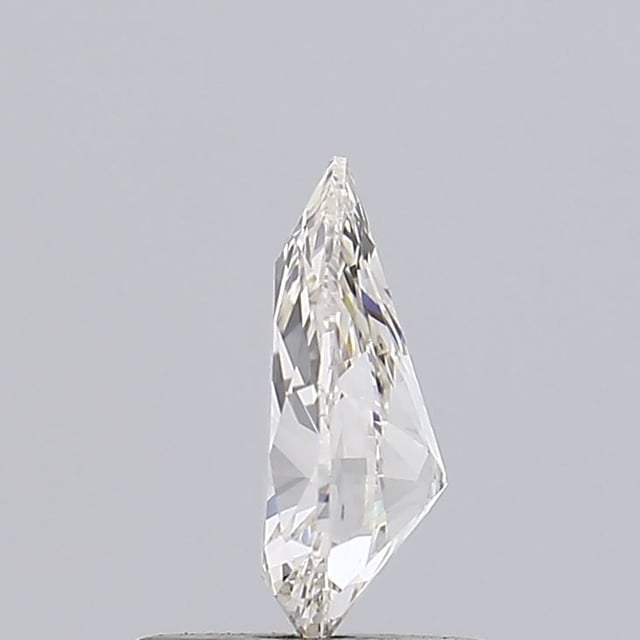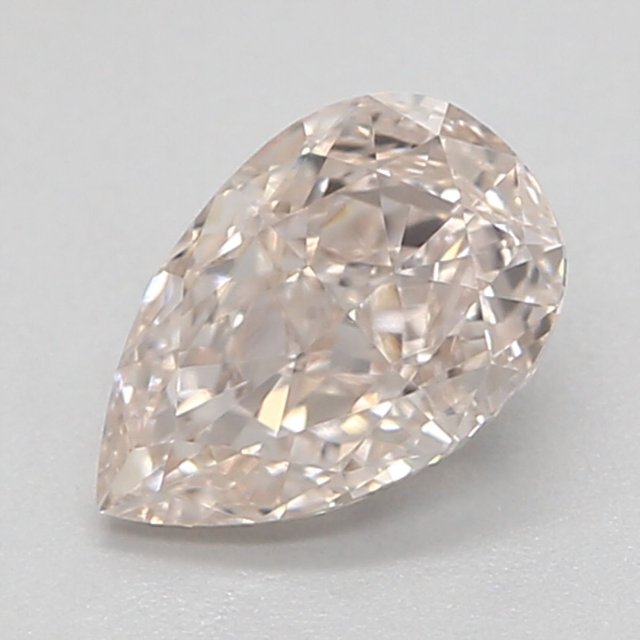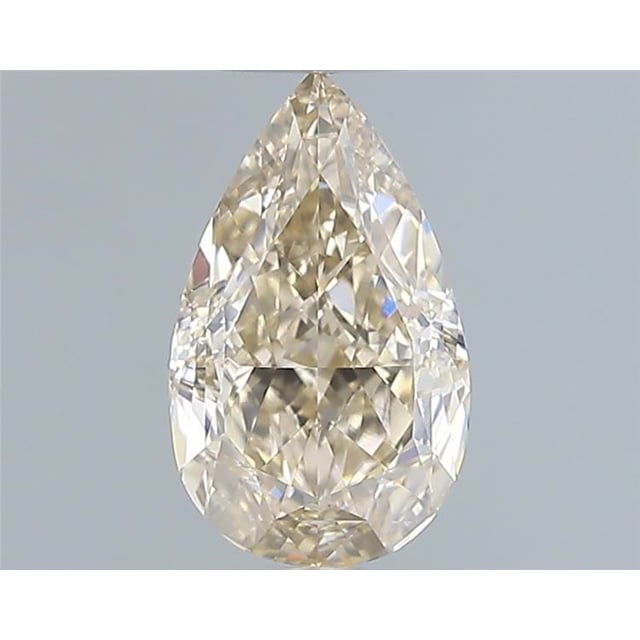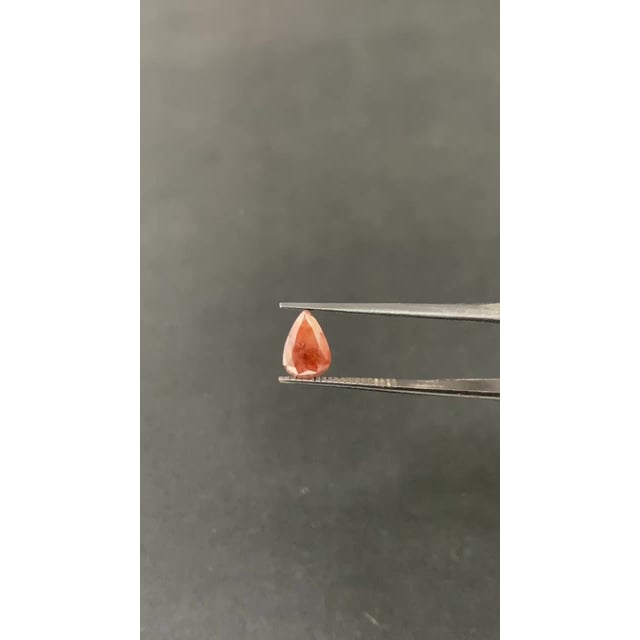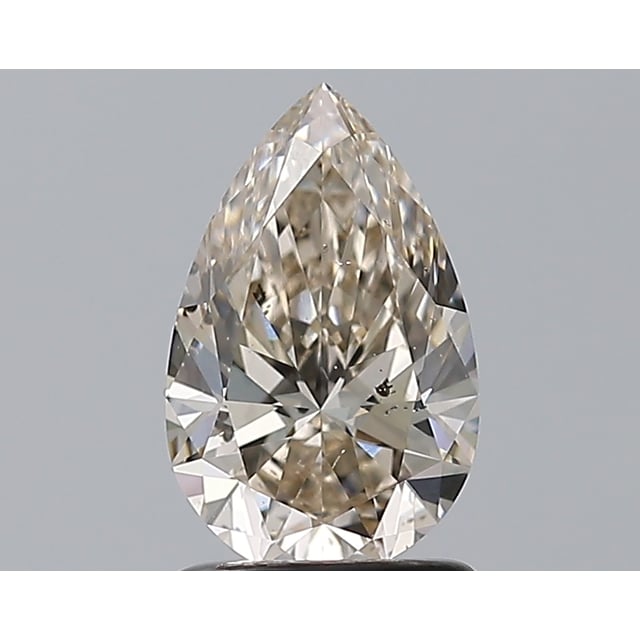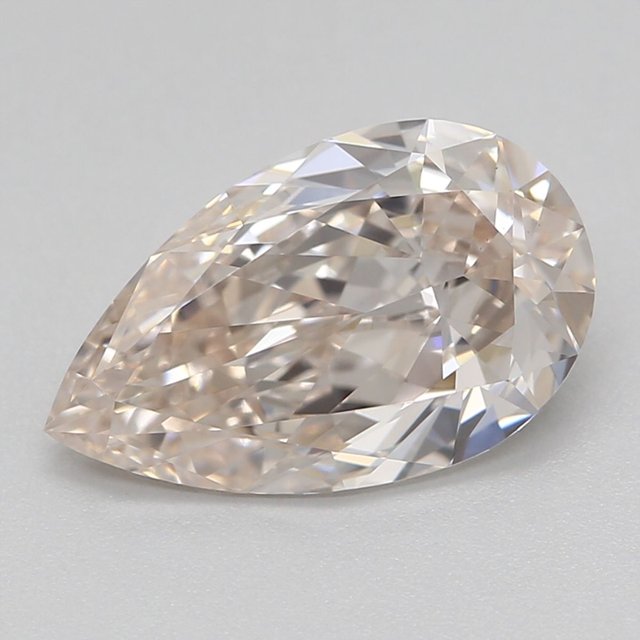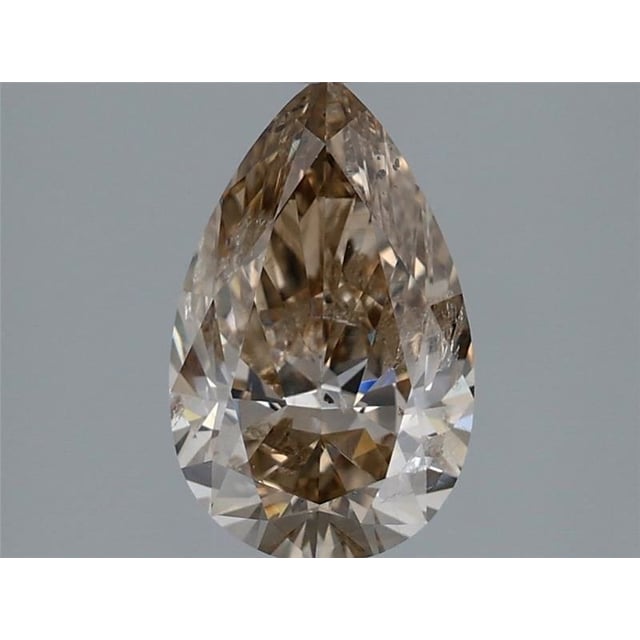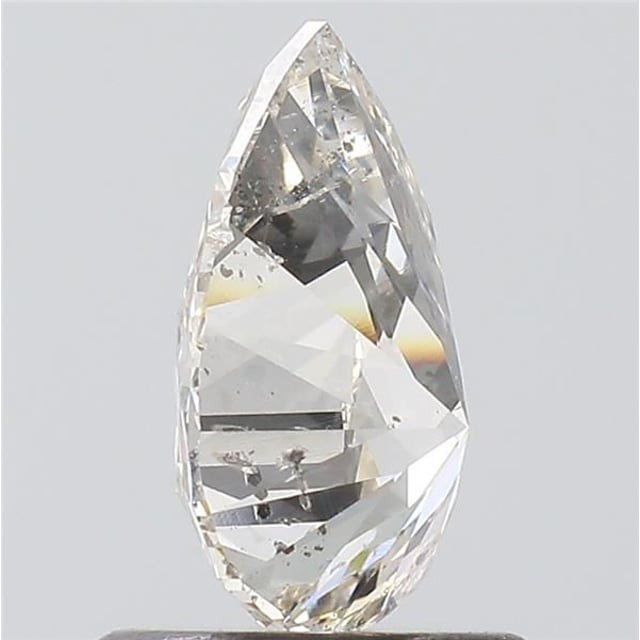
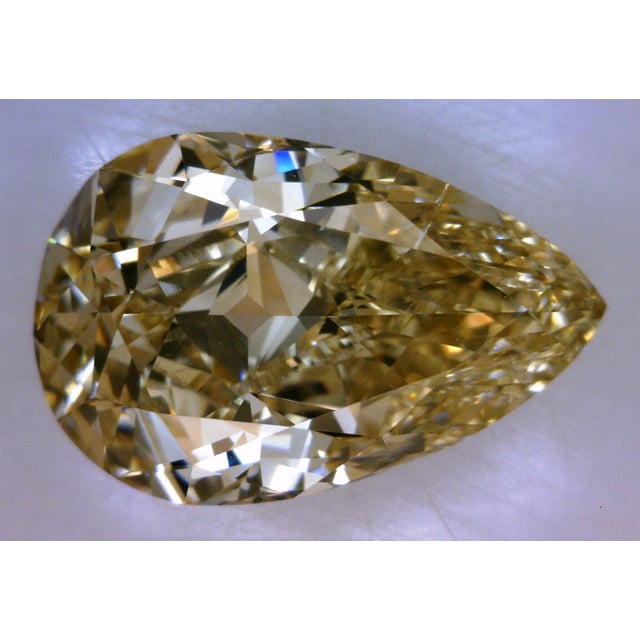
A pear puts its color where you can decide what to do about it. The tip is the part of the outline that returns light least evenly, so a warm stone shows most of its tint there and least across the broad shoulders — which means the setting, and the direction you point the stone, are doing real work on how the diamond reads. You can browse all pear champagne diamonds here; this guide is about telling them apart.
Or go straight to pear champagne diamonds at one carat and over. There are 358 pears on the site, second only to the round at 1,452 stones and ahead of the oval at 334, with a median price of $1,917. That ranking is not an accident of supply. Elongated brilliants are cut from rough that would waste weight in a round, and a faint brown tint is easier to live with in a shape that spreads its color unevenly than in one that pools it in a single central table.
What follows is the practical part: where the price sits against the other shapes, how brown behaves in an elongated brilliant, and the three things — point, symmetry, bow-tie — that separate a pear worth buying from one that photographs well and disappoints in the hand.
Where the pear sits on price
A pear champagne diamond is neither the cheapest nor the dearest stone indexed here. The round is cheaper, largely because it is the shape with the deepest supply. Emerald, princess and asscher run dearer, while cushion, oval, marquise and heart all come in below the pear. On the 17 October 2026 build:
| Shape | Stones | Median price |
|---|---|---|
| Round | 1,452 | $1,069 |
| Pear | 358 | $1,917 |
| Oval | 334 | $1,437 |
| Cushion | 183 | $1,660 |
| Marquise | 119 | $1,529 |
| Heart | 114 | $1,321 |
| Emerald | 104 | $2,395 |
The typical pear in this index sits just over a carat, and the median price of $1,917 is a figure for a stone of about that weight.
Carat weight, not shape, is what actually moves the number. Across the whole index the 1.00-1.49 ct band has a median price of $1,664 while the 0.50-0.99 ct band sits at $720. Crossing into one carat more than doubles the median outlay. The pricing guide sets out the full band structure and the matched brown-versus-non-brown comparison behind it.
The stones come from nine retailers. On the 17 October 2026 build the listing counts across all shapes ran Brilliance 1,240, Aurélinne 783, Luvansh 717, Rare Carat 675, Ritani 669, Blue Nile 500, With Clarity 203, Brilliant Earth 169 and Leibish 17, the last a fancy-color specialist whose stones are all fancy-scale.
How color concentrates at the point
A pear is a brilliant cut, so it works by returning light through a fan of facets toward the eye. In a round, that fan is symmetrical and body color reads evenly across the face. In a pear, it is not. Toward the point the facets are smaller and less able to return light evenly, so whatever body color the stone carries — a faint brown, in this case — tends to read strongest there and weakest across the wide shoulders.
Two consequences follow.
The first is cosmetic and mostly in your favor. A pear gives you a tinted region and a bright region in the same stone. Set with the point toward the fingertip, the tinted end sits at the edge of view and the broad, brighter shoulders face the observer. The same color letter can therefore read differently face-up in a pear than in a round.
The second is that the point rewards attention when you compare stones. Two pears with the same GIA grade can read differently depending on how long and how narrow the tip is: a sharply drawn point over a long ratio holds more visible color than a fuller, rounder one. GIA grades the diamond as a whole, so the report will not distinguish them. Video will.
Two kinds of stone are indexed here — of the 2,822 on the site, 2,421 sit on the D-to-Z white scale with a brown notation beside a color letter and 401 are fancy-scale stones where brown is the dominant color, and champagne versus fancy brown is the guide that sets out the difference. Most white-scale stones carry the mildest notation, Faint Brown, with a smaller group at Very Light Brown; for what that notation is and where it appears on the report, what faint brown means covers it.
The bow-tie
Every elongated brilliant has a bow-tie: a dark band across the belly of the stone where the pavilion facets are angled to return the viewer's own shadow rather than light. Pears, ovals, and marquise cuts all show it. The question is never whether a pear has one but how bad it is.
A mild bow-tie is gray, soft-edged, and moves and breaks up as the stone tilts. It gives the pear contrast and is generally read as character. A severe one is black, hard-edged, and static — a bar that stays in place regardless of angle, killing brightness across the widest part of the stone.
GIA does not grade bow-tie, and it does not issue a cut grade for fancy shapes at all — a pear's report carries Polish and Symmetry grades, which describe finish and outline, not light return. So this is judged by eye. Watch the 360-degree video full screen, and watch the belly, not the tip. If the dark band never lifts as the stone rotates, move on. There are 358 pears here; you are not short of alternatives.
Symmetry, and why it matters more here
A round can be slightly off and few people notice. A pear cannot. The eye reads the outline of an elongated shape before it reads anything about the facets, and asymmetry in the outline is the first thing that looks wrong.
Four things to check, all visible in a good top-down image:
- The point is on the axis. Draw a line from the tip to the center of the rounded end. The two halves should mirror. A tip that sits even slightly off-center gives the stone a hooked look that no setting can hide.
- The shoulders match. The curve from the point out to the widest part should be identical left and right. Uneven shoulders make one side look flat and the other bulbous.
- The belly is even. The widest point should sit at the same height on both sides.
- The wing curve is smooth. No flat spot where the shoulder turns into the round end.
Length-to-width ratio is separate from symmetry and is a matter of taste rather than quality. Longer ratios read more slender and elongate the finger; shorter ones read fuller and hold more apparent weight. Neither is graded, and neither is wrong. Cut labels are published against most stones on the site, but read them cautiously on a pear: GIA issues a cut grade for round brilliants only, so on a fancy shape the label is the retailer's own judgment rather than a laboratory grade.
Protecting the point in the setting
The tip of a pear is the thinnest, least supported part of the stone, which is why it takes a knock worse than the body does. This is the single most important practical difference between buying a pear and buying a round.
The standard answer is a V-prong: a prong shaped to wrap the tip on both sides rather than pinching it from one. It is worth asking about specifically when you choose a setting — not something to assume is fitted.
A bezel or half-bezel at the point does the same job with more metal and less sparkle at the tip. Some buyers prefer it precisely because it also masks the region where color reads strongest.
Two smaller points. Check the girdle thickness at the tip on the GIA report or the plot: an extremely thin girdle running out to the point is more fragile than a medium one, and it is worth knowing before you choose a setting. And orient the stone deliberately. Point toward the fingertip is the conventional choice and the one that keeps the tip away from the daily impacts a hand takes at its base.
If you are weighing the pear against the other elongated options, best shapes for champagne diamonds compares them on the same data. Every pear indexed here has had its GIA report read directly rather than taken from a retailer listing.