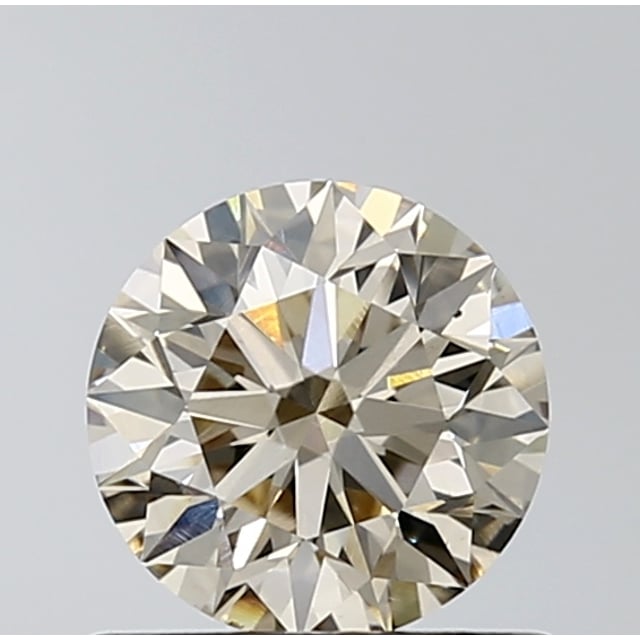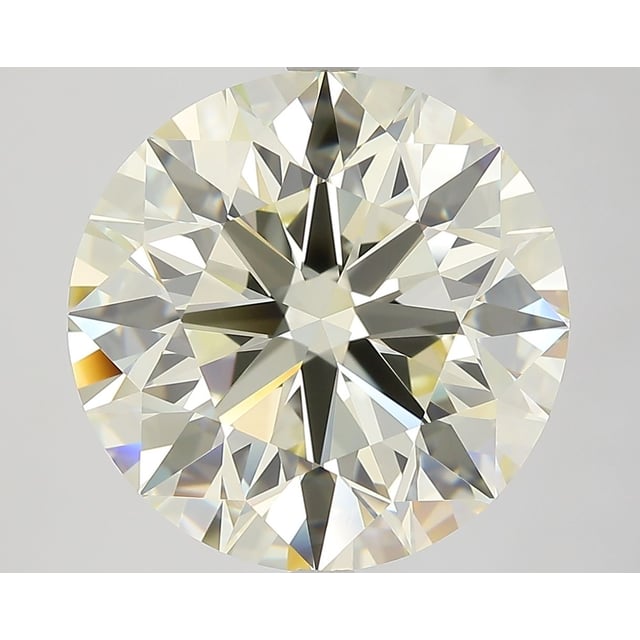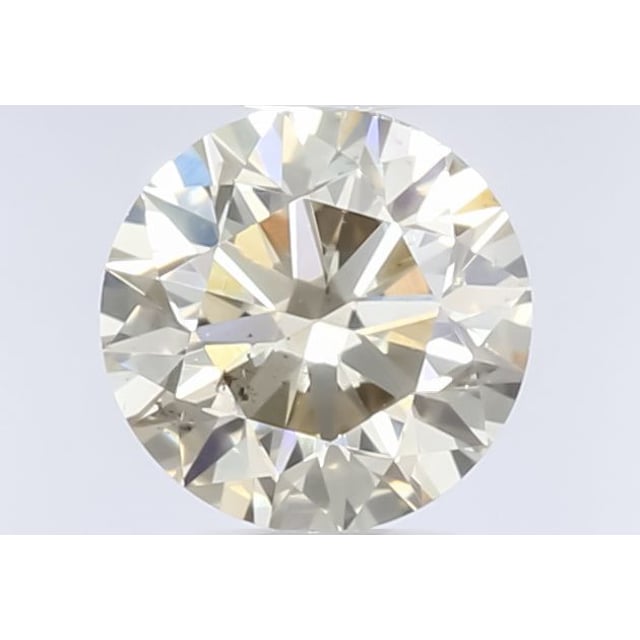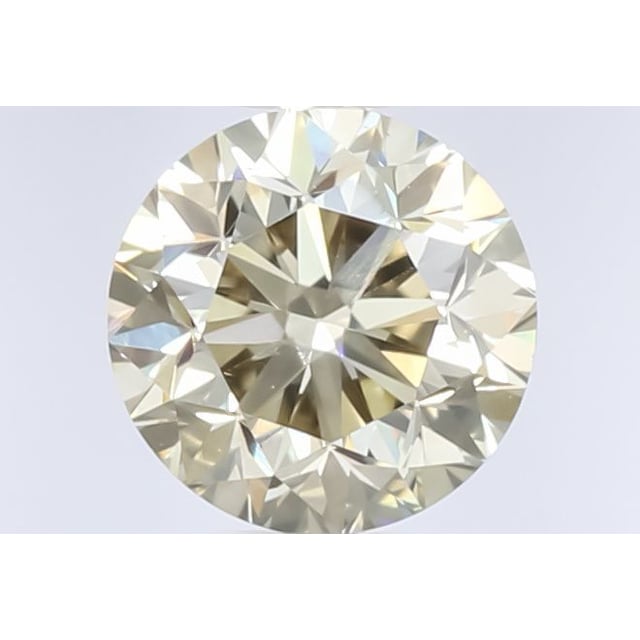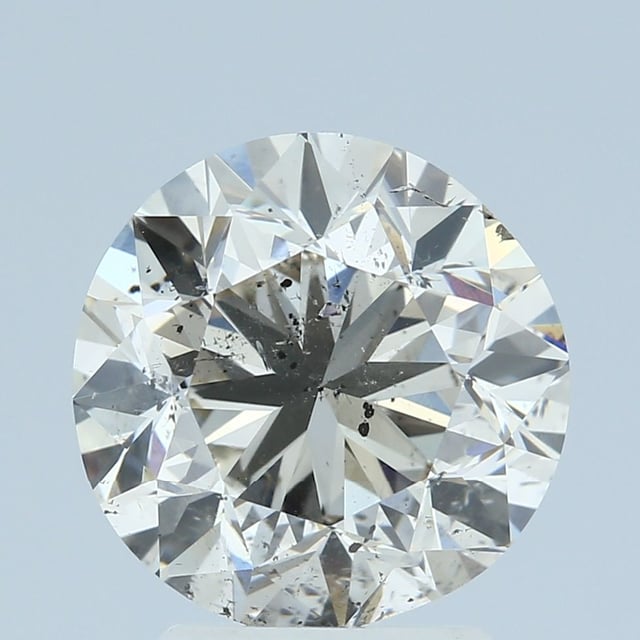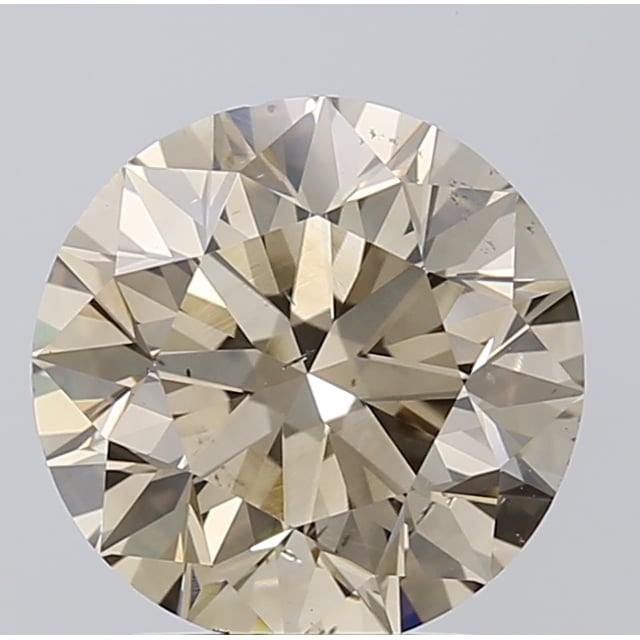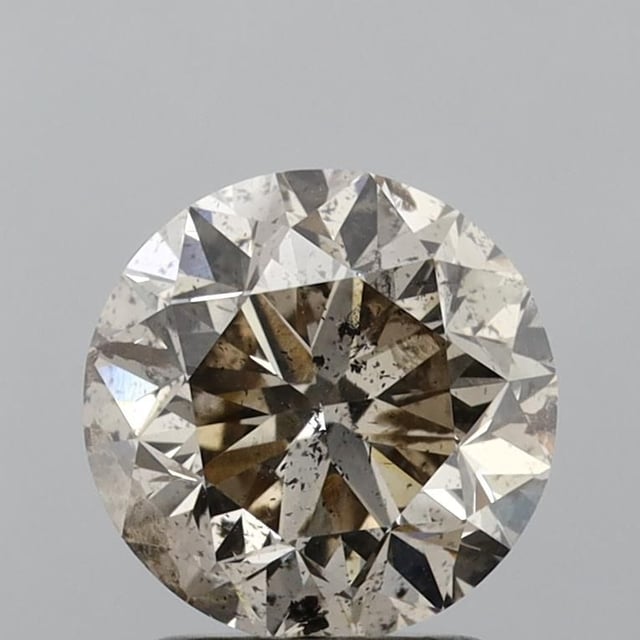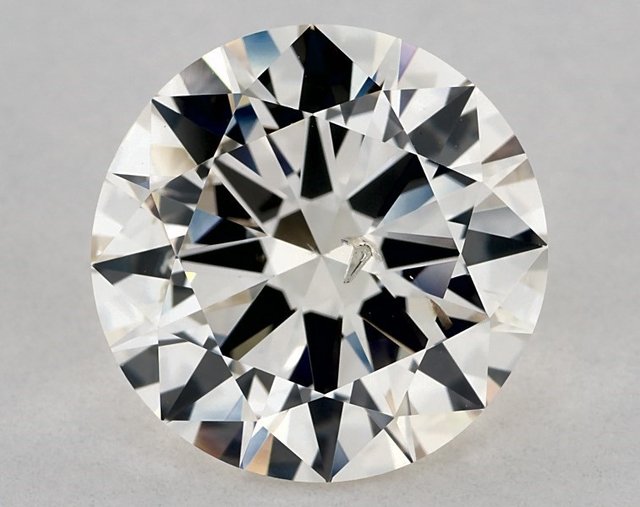
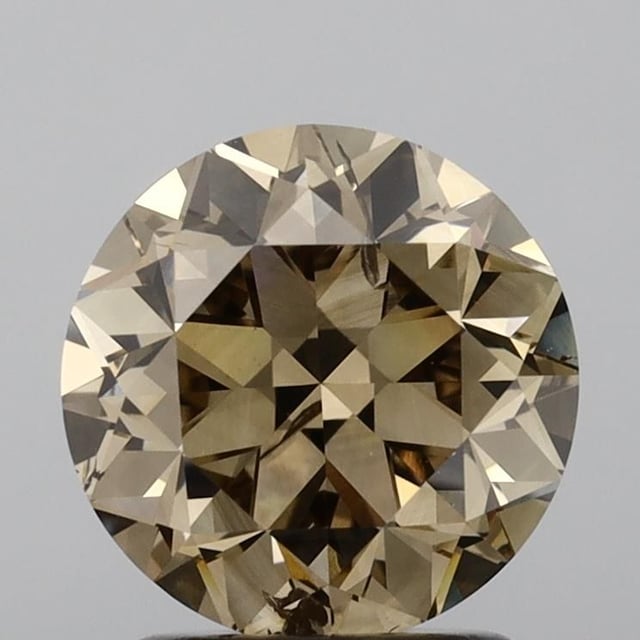
Round is the most common shape among the champagne diamonds indexed here — stones whose GIA report records brown in the color grade — and it is the cheapest by median price. Of the 2,822 stones on the site, 1,452 are round, at a median of $1,069: you can browse all round champagne diamonds, or go straight to round champagne diamonds at one carat and over. This guide is about choosing between them.
Size is not the trade-off. Round is the deepest pool on the index in every carat band, including the one-carat range most people shop for an engagement ring, so the choice is made on cut, fluorescence and color rather than on what happens to be available.
The index is not limited to D-to-Z stones carrying a brown notation: it also lists fancy-color diamonds whose dominant color is brown, and that distinction is the subject of champagne versus fancy brown. Listings are drawn from nine retailers — Aurélinne, Blue Nile, Brilliance, Brilliant Earth, Leibish, Luvansh, Rare Carat, Ritani and With Clarity.
On the D-to-Z side, what you are buying is a stone whose report reads, for example, K Faint Brown rather than plain K. The letter is the same letter used for every white diamond; the notation records that the tint reads brown rather than the yellowish cast a low-color letter usually carries. What that notation actually means is worth understanding before you compare listings, because it is the single line that separates these stones from the ones priced beside them.
How a round brilliant treats a warm tint
The modern round brilliant's geometry is built to return light through the table in a large number of small, fast flashes. That behavior is why the shape dominates the market, and why it is forgiving of body color.
Color is seen through the paths light takes inside the stone. A long, uninterrupted path shows tint clearly; many short paths, each ending in a bright return, do not. A round brilliant chops the light into short paths, so a faint brown cast, still physically present, is distributed across dozens of small returns and competes with white flashes and with dispersion. The eye tends to read the result as sparkle first and warmth second.
Step cuts do the opposite. An emerald or Asscher cut uses long parallel facets and a large open table, producing broad slabs of return light that show body color plainly. That is why a round handles a brown notation more easily, and why the two shapes should not be judged by the same standard.
Three practical consequences follow:
- Setting metal matters less in a round than in a step cut, because less of the stone's appearance is a flat wash of body color.
- Faceting hides tint best face-up. Viewed from the side, through the pavilion, a round shows its warmth as clearly as any other shape.
- A poorly cut round loses this advantage: light leaking out of the pavilion instead of returning through the table takes the sparkle with it and leaves the tint behind.
Where a round sits on price
Round is the highest-volume shape in the diamond trade, and that is reflected here. It is also the shape with the deepest supply of brown stones, which means more competing listings overall. Against the shapes it is most often weighed up next to, on the 17 October 2026 build:
| Shape | Stones | Median price |
|---|---|---|
| Round | 1,452 | $1,069 |
| Pear | 358 | $1,917 |
| Oval | 334 | $1,437 |
| Cushion | 183 | $1,660 |
| Heart | 114 | $1,321 |
| Emerald | 104 | $2,395 |
Round leads on count by a wide margin — the next shape, pear, holds 358 stones — and its median price is the lowest of any shape indexed, below the heart at $1,321. All the shapes, and how each one treats a warm tint, are compared in the guide to shapes for champagne diamonds.
What a round costs as it gets bigger
Price rises sharply with weight, and this is where most of the budget decision is made. The step from the 0.50-0.99 ct band to the 1.00-1.49 ct band lifts the median from $720 to $1,664. It keeps climbing from there: $3,136 in the 1.50-1.99 ct band, $6,865 at two carats, and $21,470 at three carats and over. Those bands cover all shapes rather than rounds alone, and the full band-by-band table, along with price behavior across the color letters, is in the pricing guide.
Cut grade: the specification that matters most
Because a round champagne diamond's ability to carry a warm tint depends entirely on light return, cut grade is not a nice-to-have here. It is the difference between a stone that reads as bright and one that reads as brownish.
The cut labels published across the index run Super Ideal, Excellent, Very Good, Ideal and Good, and some listings carry no cut label at all. These are the retailers' own tiers — GIA itself issues a cut grade for round brilliants and not for fancy shapes, and Super Ideal is a trade label rather than a laboratory one — but the round is the shape where a GIA cut grade does exist on the report to check them against. Prefer the highest cut tier your budget allows, and treat Good as a reason to look at the proportions closely rather than as a bargain.
A missing label is a fact to note rather than a defect in itself, and on a fancy shape there is no GIA cut grade to publish in the first place. On a round there is, so if the listing leaves the field blank, the grade is still on the report — go and read it.
Fluorescence on a warm stone
Fluorescence is the one specification where a champagne buyer's instincts should differ from a white-diamond buyer's. Blue fluorescence under ultraviolet light can counteract a warm cast, which is why it is often treated in the trade as a mild positive on stones in the K to N range.
A large share of listings do not publish a fluorescence value at all. That is a gap in the listing, not a grade of none, and where it matters to you the GIA report number is the place to confirm it.
Strong and Very Strong fluorescence can, in rare stones, produce a hazy look in daylight. That is worth asking about specifically rather than avoiding fluorescent stones on principle.
Color letter and brown depth in the round pool
Among the D-to-Z stones indexed here, nearly every one carries the lightest notation: 2,269 Faint Brown, 134 Very Light Brown and 18 Light Brown. By letter they run K 1,348, L 559, M 251 and N 129.
That concentration matters when shopping rounds. A K Faint Brown in a well-cut round brilliant is a subtle stone — warm in a way that shows most against a bright white metal and least in yellow or rose gold. Very Light Brown sits one step deeper on the notation, and there are far fewer of those stones to choose from: 134, against 2,269 Faint Brown.
Set against non-brown diamonds of the same letter and weight — the notation discount — the white-scale brown stones ran a median 20 percent cheaper per carat across the 11 matched comparisons of the 2 September 2026 study, with the widest single gap at 31 percent and two sub-carat groups — L and M at 0.50-0.99 ct — where the brown stones were level with or more expensive than the non-brown ones. Below one carat the notation is unreliable: 19 percent at K, but negative at both L and M. From 1.50 ct upward it is consistent, with all five cells at that weight and above running 26 to 31 percent. In the 1.00-1.49 ct K band, 316 brown stones had a median of $1,813 per carat against $2,191 for 1,611 non-brown stones of the same letter — a 17 percent difference for a notation on the report. That is a narrower measure than the champagne discount against a near-colorless G–H stone shown on each card. K, L, M and N color reads the same comparison letter by letter.