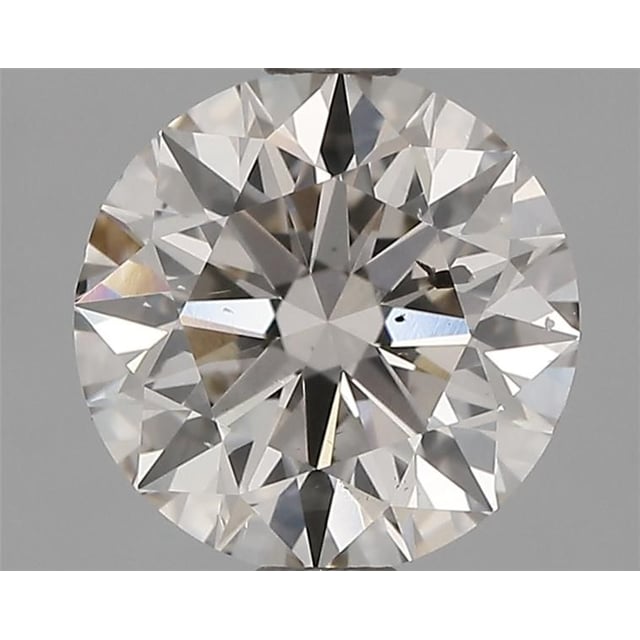
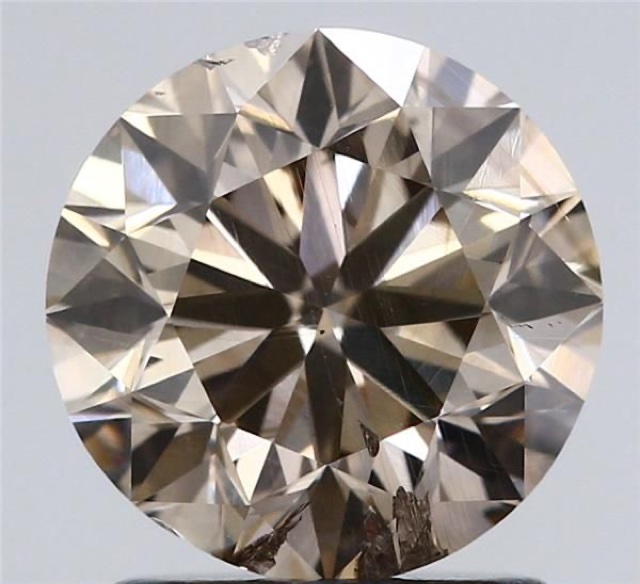
A champagne diamond costs less than an untinted diamond of the same size, and this site carries two separate figures for how much less. The narrower one is the price of the wording itself: across eleven matched color-and-carat cells measured on 2 September 2026, stones whose GIA report carries a brown notation ran a median 20 percent below stones of the same color letter and carat band whose reports carry none. The wider one is the struck-through figure on every card, against a similar near-colorless G–H diamond: a median 44 percent among the stones below it. Both are asking prices rather than completed sales, and both depend more on carat weight than on the tint.
On the 2026-10-08 data snapshot this index held 2,631 unique natural brown diamonds, deduplicated by GIA report number, across 4,896 retailer listings at nine retailers. 2,421 are white-scale, graded D-to-Z with a brown notation beside an ordinary color letter; 401 are fancy-scale, with brown named as the dominant color and no letter at all. The two are priced separately, because only a lettered stone can be matched letter for letter.
Two discounts, two benchmarks
The notation discount compares a brown-notation stone with a stone of the same color letter and carat band whose report carries no brown notation. On the 2 September 2026 study it ran a median of about 20 percent, and it exists only for white-scale stones.
The champagne discount is the struck-through price on every card. Its comparator is a near-colorless G–H natural GIA-graded stone of the same shape, the same clarity with no widening to an adjacent grade, the same cut tier on GIA's Excellent, Very Good and Good scale, and a carat weight inside a window drawn so it never crosses a trade threshold where price per carat steps up; the figure taken is the lower quartile of those matched prices per carat. It is the larger number because it prices the whole gap between a warm stone and a near-colorless one, letter included, not just the word "Brown" on the report. The method is on the prices page and in how our price benchmark works.
What counts as champagne here
A white-scale stone counts only if GIA wrote a brown notation into the color grade line — Faint Brown, Very Light Brown or Light Brown — read off the report rather than taken from a retailer calling a stone champagne. A fancy-color stone clears two conditions instead: brown must be the dominant color, which GIA signals by writing it last, and the stone must cost less per carat than the median untinted D-to-Z stone of its carat band. The fancy scale here has two steps, 349 Fancy Brown and 52 Fancy Light Brown; GIA's darker intensities are not carried here, and both screens are in how we verify every stone.
How the per-letter comparison was made
On the 2 September 2026 study the brown stones were set against 12,501 stones on the same scale, at the same K, L and M letters, whose reports carry no brown wording at all. Each cell holds the letter and the carat band fixed and takes each group's median price per carat — medians rather than averages, so one unusual stone cannot move a cell. Cells too thin on either side go unreported.
Plenty is still uncontrolled: clarity, cut grade and fluorescence all move price and are not balanced across the groups. Read the table as a market observation, not a controlled experiment.
The headline table
The eleven cells of the 2 September 2026 study. These compare against stones outside the index, so they cannot be recomputed from current listings and are not refreshed with the build:
| Color | Carat band | Brown stones | Brown median $/ct | Non-brown stones | Non-brown median $/ct | Discount |
|---|---|---|---|---|---|---|
| K | 0.50-0.99 ct | 473 | $1,095 | 2,007 | $1,354 | 19% |
| K | 1.00-1.49 ct | 316 | $1,813 | 1,611 | $2,191 | 17% |
| K | 1.50-1.99 ct | 195 | $2,333 | 1,154 | $3,322 | 30% |
| K | 2.00-2.99 ct | 89 | $3,874 | 619 | $5,470 | 29% |
| L | 0.50-0.99 ct | 121 | $1,165 | 1,217 | $1,155 | -1% |
| L | 1.00-1.49 ct | 101 | $1,563 | 812 | $1,955 | 20% |
| L | 1.50-1.99 ct | 64 | $2,002 | 748 | $2,719 | 26% |
| L | 2.00-2.99 ct | 35 | $3,245 | 368 | $4,454 | 27% |
| M | 0.50-0.99 ct | 56 | $1,155 | 554 | $1,015 | -14% |
| M | 1.00-1.49 ct | 75 | $1,598 | 379 | $1,816 | 12% |
| M | 1.50-1.99 ct | 39 | $1,763 | 426 | $2,549 | 31% |
The median across these eleven cells is 20 percent, ranging from a 14 percent premium to a 31 percent discount; a negative number means the brown stones in that cell were dearer. None of it describes fancy-scale stones, and none of it is the champagne discount against a near-colorless G–H stone.
The pattern is size, not color
Down each letter the discount broadly widens with size, though not step by step. K goes 19, 17, 30, 29 percent. L goes -1, 20, 26, 27 percent. M goes -14, 12, 31 percent. Both anomalies sit in the smallest matched band, where price is set mainly by weight and clarity and warmth that is hard to see face-up does little work; those two cells hold only 121 and 56 brown stones. At 1 carat the discount runs from 12 to 20 percent; at 2 carats it is in the high twenties. The tint buys real money above 1.5 carats, some around 1 carat, and nothing you can count on below — the argument of champagne diamond carat weight.
Where the fancy-scale stones sit
Fancy stones have no letter to match on, but they can be matched by weight. On the 3 September 2026 merge their median price per carat sat below the white-scale browns in every matched band, and both sat below the untinted figure. Part of that is built in, since a fancy stone is admitted only when it undercuts the untinted median for its size. Band-by-band numbers are in the FAQ above and in where to buy.
Price by carat band
Both scales together, on the 6 September 2026 build — the most recent band-by-band medians computed, and older than the snapshot figures above:
| Carat band | Stones | Median price |
|---|---|---|
| under 0.50 ct | 372 | $290 |
| 0.50-0.99 ct | 844 | $720 |
| 1.00-1.49 ct | 742 | $1,664 |
| 1.50-1.99 ct | 425 | $3,136 |
| 2.00-2.99 ct | 258 | $6,865 |
| 3 ct and over | 165 | $21,470 |
The median multiplies roughly seventyfold from the smallest band to the largest. A brown notation moves a stone down that curve by a percentage; it does not flatten it. For scale, the index median on the 2026-10-08 snapshot was $1,393, from $92 to $242,530.
Price by shape
Counts from the 2026-10-08 snapshot; the medians from the 6 September 2026 build, the last day they were computed by shape. The two columns describe different populations, so read the second as rough scale:
| Shape | Stones, 8 October | Median price, 6 September |
|---|---|---|
| Round | 1,341 | $1,069 |
| Pear | 329 | $1,917 |
| Oval | 303 | $1,437 |
| Cushion | 191 | $1,660 |
| Marquise | 109 | $1,529 |
| Heart | 109 | $1,321 |
| Emerald | 100 | $2,395 |
| Radiant | 80 | $1,551 |
| Asscher | 36 | $2,602 |
| Princess | 20 | $2,591 |
Each shape carries its own mix of sizes, colors and clarities, so these describe the listings rather than isolate a shape effect. Round holds 1,341 of the 2,631 stones and carried the lowest median; asscher, princess and emerald carried the highest, and all three skew large. How each outline handles a tint is in best shapes.
What our index shows — data snapshot 2026-10-08
2,631 unique verified natural brown diamonds, deduplicated by GIA report number, across 4,896 retailer listings at nine retailers, with 1,166 stones listed at more than one retailer. By GIA wording: 2,089 Faint Brown, 129 Very Light Brown, 18 Light Brown, 343 Fancy Brown, 52 Fancy Light Brown. Median asking price $1,393, range $92 to $242,530. 2,323 stones sit below their matched near-colorless G–H benchmark, at a median discount of 46%. Asking prices on one snapshot, not completed sales.
What "brown" means in this data
Nearly all of the white-scale side is the faintest grade: 2,269 Faint Brown, 134 Very Light Brown and 18 Light Brown, running 1,348 K, 559 L, 251 M and 129 N by letter. This is near-colorless material with one extra word on the GIA grading report, and the roughly 20 percent median notation discount is the price of that word; what faint brown means covers how visible it is face-up.
The fancy-scale stones are a different proposition. Their color is the point of them rather than a footnote to a letter, which is why they are graded on a scale that names a hue instead of ranking the absence of one.
One comparison here holds the diamond itself fixed and is neither discount: where the same GIA report number is listed by more than one retailer — 1,166 stones on the 2026-10-08 snapshot — the only variable left is the store, which why the same champagne diamond costs different amounts takes up.







