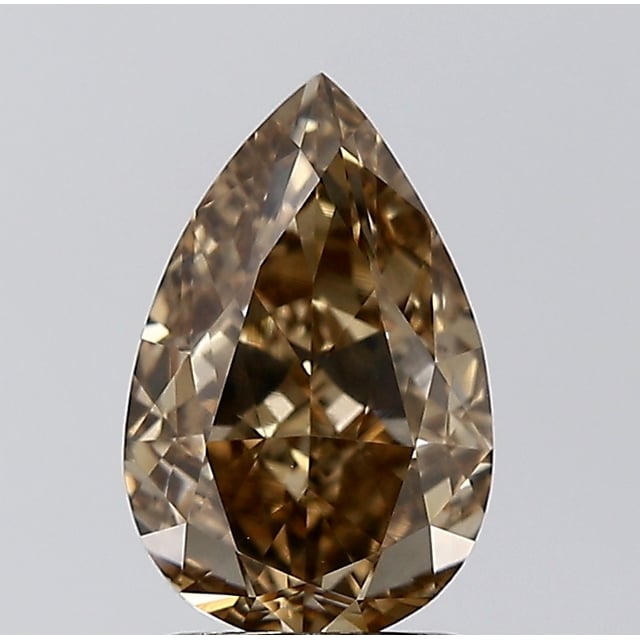
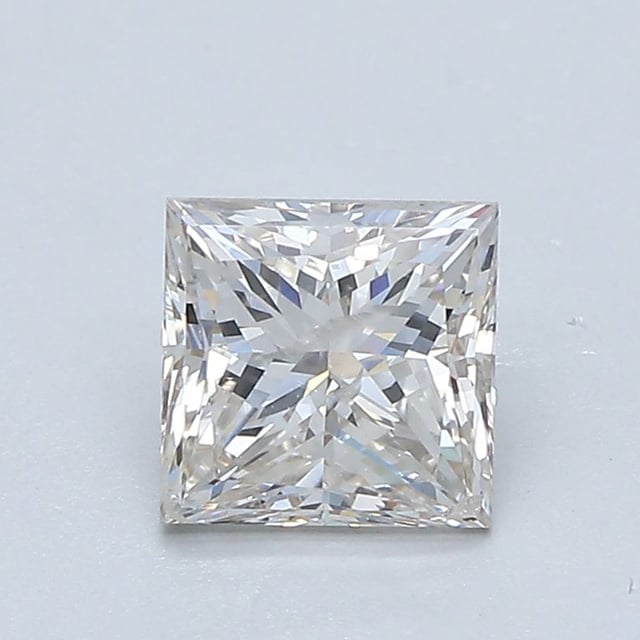
A few retailers do sell champagne diamonds as a category. LEIBISH runs a champagne collection and Blue Nile has a brown fancy-color page, but those are fancy-color categories, and they reach only a small corner of this market. The 2,822 stones indexed here are scattered across nine online diamond inventories, filed under ordinary color grades, and the thing that makes them champagne is either a brown notation buried in the GIA report or, on a fancy stone, the wording of the grade itself.
Two different kinds of stone are involved. 2,421 are white-scale: graded on the D-to-Z letter scale, mostly K through N, with a brown notation written beside the letter. The other 401 are fancy-scale, graded as colored diamonds with no letter at all, and admitted here only when brown is the dominant color and the stone costs less per carat than the median untinted D-to-Z stone of the same carat band.
Where you buy either kind comes down to which of nine inventories is holding the stone: Aurélinne, Blue Nile, Brilliance, Brilliant Earth, Leibish, Luvansh, Rare Carat, Ritani and With Clarity. This site holds no inventory and sells nothing. It reads the GIA report for each stone, records the color wording, and links out to whichever retailer holds it.
How many stones each retailer lists
On the 17 October 2026 build:
| Retailer | Stones listed |
|---|---|
| Brilliance | 1,240 |
| Aurélinne | 783 |
| Luvansh | 717 |
| Rare Carat | 675 |
| Ritani | 669 |
| Blue Nile | 500 |
| With Clarity | 203 |
| Brilliant Earth | 169 |
| Leibish | 17 |
Those counts describe listings, not distinct stones, which is why they add to more than the 2,822 stones on the site: a stone carried by two retailers is counted by both. 1,194 stones sit in more than one retailer's inventory at the same time, so a meaningful share of this market is one overlapping population rather than several separate ones.
With Clarity, Brilliant Earth and Leibish are an order of magnitude behind the leaders. Leibish is small here for a different reason: it is a fancy-color specialist rather than a general white-diamond inventory, so almost nothing it lists is a white-scale stone.
The fancy-color side
Not every brown fancy stone Leibish or anyone else lists appears here. A fancy-color stone is indexed only when two things hold at once.
Brown has to be the dominant color. GIA writes the dominant color last in a fancy grade, so "Fancy Pink Brown" is a brown stone and qualifies, while "Fancy Brown Pink" is a pink stone and does not. The word order is the whole distinction.
It has to cost less per carat than the median untinted D-to-Z stone in the same carat band. Fancy color is often a premium rather than a discount, and stones priced as a premium fall outside what this index is for.
On the 3 September 2026 merge that pass rejected 1,342 of the fancy-color stones it read: 628 were not brown-dominant, 509 were not cheaper per carat, 133 carried letterless colored-report grades that duplicate the white-scale wording, and 72 were too dark.
The fancy scale here has two steps: 52 Fancy Light Brown and 349 Fancy Brown. The GIA scale continues past those into darker and deeper grades, but this site stops at Fancy Brown, because beyond it the stone reads as cognac or near-black rather than champagne. Most of the stones that do qualify carry a modifying color ahead of the brown: on the 3 September 2026 merge Fancy Yellow Brown was the most common full grade at 126 stones, then Fancy Yellowish Brown at 79, unmodified Fancy Brown at 26, and Fancy Light Yellowish Brown at 23.
These stones have no color letter at all, so none of the per-letter figures elsewhere on this site apply to them.
What each retailer exposes on the listing page
The difference this site can report on is not price and not selection, but what the listing page tells you before you have to talk to anyone.
The GIA report number. That single field is what makes a stone checkable: with it you can pull the grading report yourself and read the color line, the only place the brown wording lives. Where a listing does not show it, ask before treating the color as known. Everything here is verified from the report itself; the method is set out in how we verify every stone.
Images. Brown in a champagne diamond is a body tint, and it reads differently under different light and at different angles. A single still image is a weak basis for judging how a Faint Brown K will look on a hand.
How far down the scale they stock. On the 17 October 2026 build the letters run 1,348 K, 559 L, 251 M and 129 N. More of the brown notation sits in K than in every other letter combined, so a retailer that stocks K at all is holding most of this market; a list that stops at K removes every L, M and N stone on the index. The guide to K, L, M and N color diamonds covers what those letters mean before the notation is added.
Grading detail. On a white-scale stone the brown notation sits on the GIA report and is not part of the letter grade, which is why it never appears alongside carat, color, clarity and cut in listing data: a K with a Faint Brown notation is listed simply as a K. Fancy-scale stones do not have this problem, because the brown is named in the grade itself.
The filter that does not exist on the white scale
On the white scale, the color filter is a row of letters. You can ask for K. You cannot ask for K with a brown notation, and you cannot ask to exclude it. LEIBISH's champagne collection and Blue Nile's brown fancy-color page are category pages for fancy-color stones; neither reaches the lettered stones that make up most of this index.
So a search for K diamonds returns two populations mixed together: stones whose GIA color grade reads as a plain letter, and stones whose grade carries a brown notation. They look identical in a thumbnail grid and are described identically in the specification table, but they are not priced identically. That gap is the notation discount — a brown-notation stone measured against a stone of the same color letter and carat band with no brown notation. Across the eleven matched color-and-carat cells of the 2 September 2026 study the brown stones ran a median 20% cheaper per carat, and from 1.50 ct upward every cell measured fell between 26% and 31%. Below one carat the gap is unreliable — 19% at K, nothing at L, and a 14% premium at M. That comparison covers white-scale stones only, and it is a different measurement from the champagne discount struck through on every card, which sets a stone against a similar near-colorless G–H diamond at the lower quartile of current listings.
While verifying the brown stones here, the same process passed over 12,501 same-scale K to M stones with no brown notation at all. The 1,860 brown K, L and M stones counted on the 2 September 2026 study were about 13% of that combined population — roughly one stone in eight, unlabeled and unsortable.
That is the reason this index exists: every stone here has had its report read and its color wording recorded, so Faint Brown and Very Light Brown are separable categories rather than a phrase buried in a PDF. What the notation says is covered in what Faint Brown means.
Comparing prices across the lists
Because stones are multi-listed, price comparison between retailers is possible in a way it usually is not: the same report number, the same stone, more than one price. The site's per-stone pages link to each retailer holding it.
The two scales also price differently against each other. Median $/ct in matched carat bands, measured on the 3 September 2026 merge, before the darkest fancy grades came off the list:
| Carat band | Fancy-scale browns | White-scale browns | No brown notation |
|---|---|---|---|
| 1.00-1.49 ct | $1,053 | $1,687 | $2,059 |
| 1.50-1.99 ct | $1,364 | $2,136 | $2,972 |
| 2.00-2.99 ct | $2,504 | $3,542 | $4,843 |
| 3 ct and over | $4,060 | $7,294 | $8,271 |
Part of that ordering is built in: a fancy stone is here only if it undercuts the untinted median for its size. That the fancy column also sits below the white-scale one is not forced by the rule. Full figures are in the champagne diamond prices guide. On the 2 September 2026 merge the white-scale median price was $1,445, ranging from $197 for a 0.27 ct round to $951,425 for a 20.29 ct oval, Faint Brown VVS1.
Availability by shape is uneven. On the 17 October 2026 build round accounts for 1,452 stones, more than every other shape combined. Pear is next at 358 and oval at 334; emerald holds 104, radiant 81, and asscher 34.
Terms and reports
Two things this site cannot tell you. The first is terms: shipping, returns, resizing, warranty and any current promotion are set by each retailer and change without notice. The current policy is on the retailer's site.
The second is the report. On a champagne diamond, the color line of the GIA report is the entire product description — the letter grade alone does not carry it, and on a fancy stone the word order in the grade decides whether it is a brown diamond at all. A listing that cannot produce a report number offers nothing to verify.







