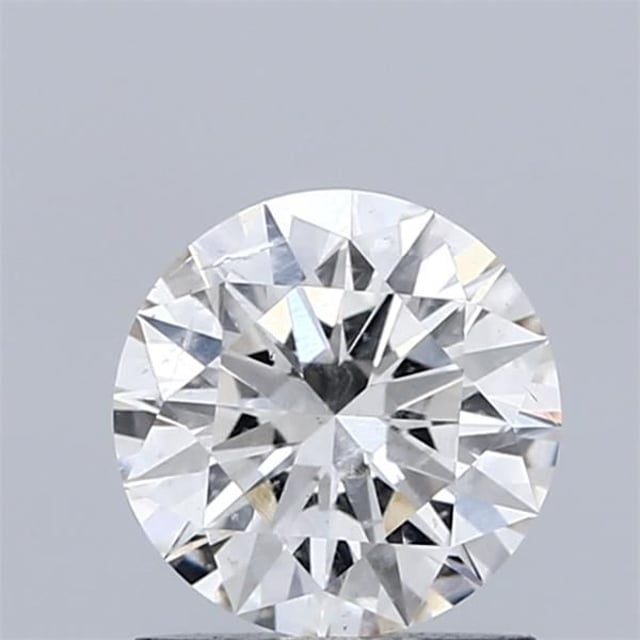
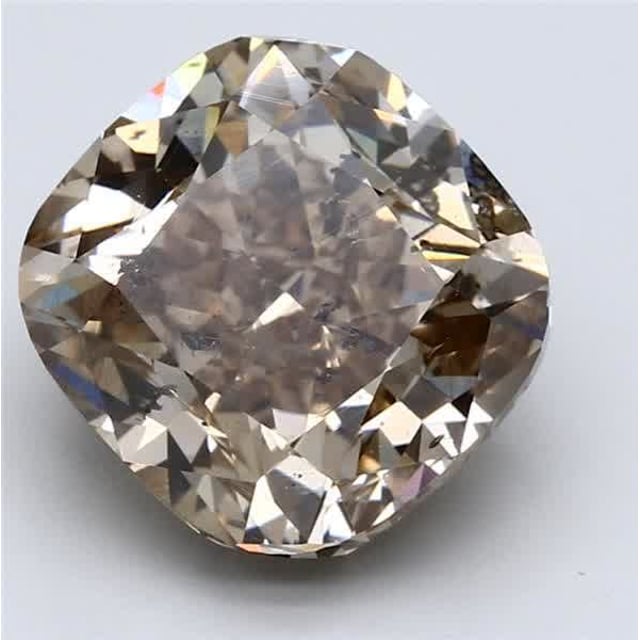
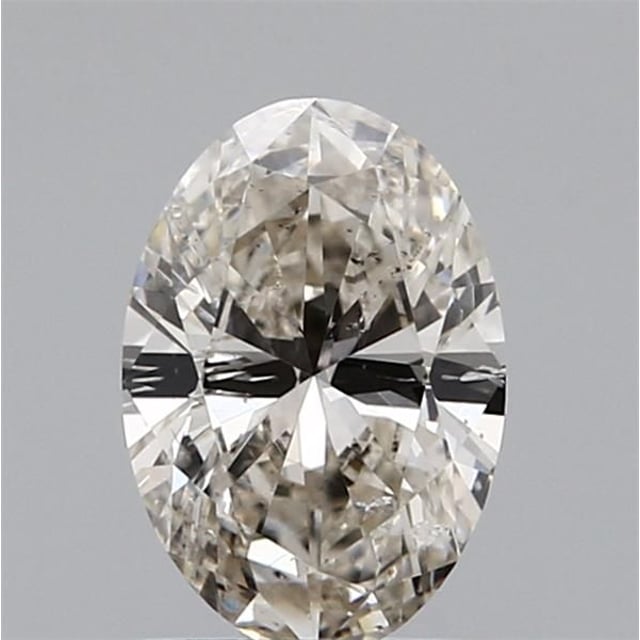
Yes, and the brown notation is not what decides it. Sparkle comes from cut — from how completely a diamond's facets return light to the eye — and color is what tints the light that comes back. GIA grades the two separately. A report reading K Faint Brown records the warmth on the color line and says nothing there about brightness; the cut grade beside it is assigned on the same scale used for a stone with no notation at all.
The practical difficulty is different, and it catches most shoppers out: on the majority of champagne diamonds there is no cut grade on the report to read. GIA's 4Cs pages, checked on 17 October 2026, state that "Diamond cut grades are only given to round brilliant cut diamonds because they are the only cut that have standardized facets." On the 2026-10-17 data snapshot, 1,460 of the 2,822 natural brown diamonds indexed here are round. For every other stone, the specification that decides whether it looks bright is the one line the report leaves out.
What a cut grade is actually measuring
GIA grades cut from Excellent to Poor, and its published components fall into three groups. Face-up appearance covers brightness, "the total internal and external reflection of white light"; fire, "the dispersion of light into the colors of the spectrum"; and scintillation, "the pattern of light and dark areas, and the sparkle when moved." Design covers weight ratio and durability. Craftsmanship covers polish, "the overall condition of a finished diamond's facet surfaces," and symmetry, "the exactness of the shape and the placement of a diamond's facets."
Nothing on that list is body color. That is the answer to the sparkle question in one line: the grade that measures sparkle does not take the tint into account, and the notation that records the tint does not move the grade. Where the two meet is in what you see — a stone returning plenty of light returns warm-tinted light, and a stone leaking light through the pavilion returns less of everything while the body color stays exactly where it was. What faint brown means covers the notation itself.
Which stones can carry a cut grade, and which cannot
Two separate limits apply, and they are easy to confuse.
The first is shape. Only standard round brilliants get an overall cut grade. Every pear, oval, cushion, marquise, emerald, radiant, asscher and princess is a fancy shape in GIA's sense and receives none.
The second is scale. A diamond whose brown is graded as a fancy color is described on a colored-diamond report rather than a D-to-Z one. GIA's comparison of those reports, checked on 17 October 2026, lists color grade and origin, clarity grade, carat weight, measurements, plotted clarity diagram, polish and symmetry, fluorescence and testing for treatments on the Colored Diamond Grading Report — and no cut grade. The shorter Colored Diamond Identification and Origin Report carries no clarity grade, no fluorescence and no polish and symmetry either. Which report a warm stone is eligible for is set out in which GIA report a champagne diamond carries.
What our index shows — data snapshot 2026-10-17
2,822 unique verified natural brown diamonds, deduplicated by GIA report number, across 5,088 retailer listings at nine retailers, with 1,189 of those stones listed at more than one retailer. By shape, 1,460 are round — the only outline GIA assigns a cut grade to — against 347 pear, 310 oval, 211 cushion, 116 marquise, 113 heart, 106 emerald, 91 radiant, 36 asscher, 22 princess and a few others. By GIA wording, 350 are Fancy Brown and 51 Fancy Light Brown: 401 stones on the fancy-color scale, whose reports carry no cut grade whatever their shape. The index holds fancy-scale rounds, so those two groups overlap and cannot be added together. Median asking price $1,410, range $92 to $224,546. 2,434 stones are listed below their matched near-colorless G–H benchmark, at a median discount of 44%. Retailer asking prices on one snapshot, not records of completed sales.
A fancy-color brown is cut for a different result
With fancy-color stones the absence of a cut grade is less of a gap than it first looks, because the cutter was not chasing the same thing. GIA's guidance is direct: "Colored diamonds are usually cut to maximize the intensity of their color rather than to maximize light return," and "The best cut is one that gives the most attractive face-up color." Its explanation of why runs through path length — "the larger a diamond is, or the deeper its pavilion, the farther light can travel in it. This can often lead to a richer, more intense color" — and it notes that cutters found certain mixed cuts, the radiant in particular, intensify color in stones toward the lower end of the D-to-Z scale.
So a Fancy Brown radiant or cushion that reads deep and saturated rather than glassy and bright is doing what it was cut to do. Judging it by round-brilliant light return misreads the stone. Choosing a radiant cut champagne diamond works through that trade-off on the shape built for it.
What you do get on a fancy shape
Finish. GIA's own buying guide for these shapes puts it plainly: "While GIA does not grade the overall proportions of fancy cut diamonds, a GIA Diamond Grading Report does contain an assessment of the diamond's Finish, which includes Polish and Symmetry." Excellent or Very Good on both is an indicator of careful work rather than a verdict on light return, and it is the nearest thing to a craftsmanship grade these stones have.
The same guide notes that ovals cut in the brilliant style show brightness similar to round brilliants, and that shallow stones may appear less bright — the single most useful thing to look for in a video, since a shallow fancy shape tends to show a pale window through the middle where the light should be coming back. How to read that from listing photography, and why two photographs of one stone disagree, is in what does a champagne diamond look like.
How cut and tint interact face-up
Faceting style changes how the warmth is distributed as much as how much light returns. A brilliant arrangement breaks the return into many short flashes, which the eye tends to read as sparkle before it reads as color. A step cut uses long parallel facets and a broad table, and returns light in wide slabs that show body color openly — which is why an emerald cut of the same grade looks warmer than a round. Neither is better; they show the same stone's color differently, and best shapes for champagne diamonds compares them outline by outline.
What is consistent is the direction of a cutting error. Light that leaks out of the pavilion instead of returning through the table takes the sparkle with it and leaves the tint in place, so cut quality matters more on a warm stone than on a colorless one of the same proportions.
Cut also decides which price comparison this index can make
The struck-through figure on every card compares a stone against similar near-colorless G–H diamonds matched on shape, on the same clarity grade with no widening, on a carat window drawn so it never crosses a trade threshold, and on the same cut tier — read on GIA's Excellent, Very Good and Good scale, the one scale every source shares. Retailer sub-grades are mapped onto it first: Ideal, Super Ideal, RC Ideal and True Hearts are treated as Excellent, which slightly understates what a curated stone is saving rather than overstating it.
Where a listing publishes no cut at all, that tightest match is unavailable, and the comparison falls back to a looser one that ignores cut. Each step only ever admits cheaper comparators, so a looser match can lower the struck-through price but never raise it, and the card's tooltip names the step used. The method in full is on the prices page and in how our price benchmark works.
What changes, and when
GIA has said it will introduce a cut grade for selected fancy shapes, with a formal launch in 2027 and further detail promised early that year; marquise, oval and pear are the outlines named. Nothing is retroactive — every report already issued stands as it is. Our report on the trade's move toward fancy shapes, cutters have moved to fancy shapes, covers what that leaves a buyer to assess in the meantime.
Until then the checks are the same on every warm stone: confirm the report number resolves, read the cut grade if the stone is a round brilliant and the finish grades if it is not, watch a video for a dull or washed-out center, and compare the asking price against the same stone at other retailers rather than against a different diamond. The two rules that admit a stone here are in how we verify every stone.







