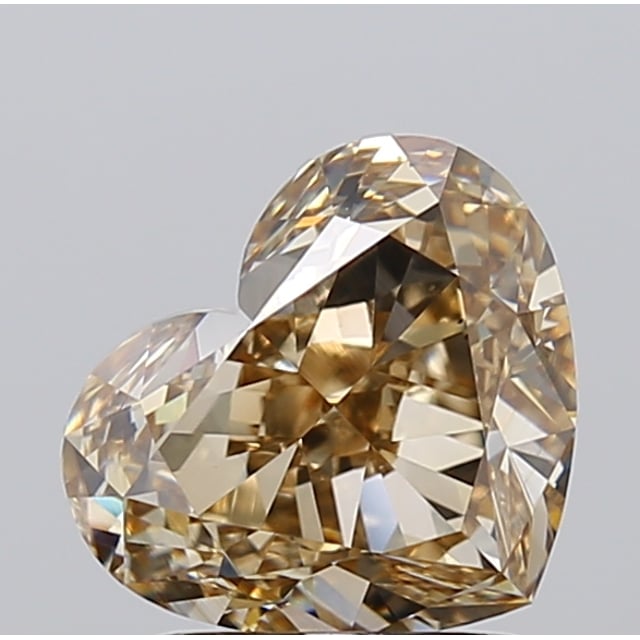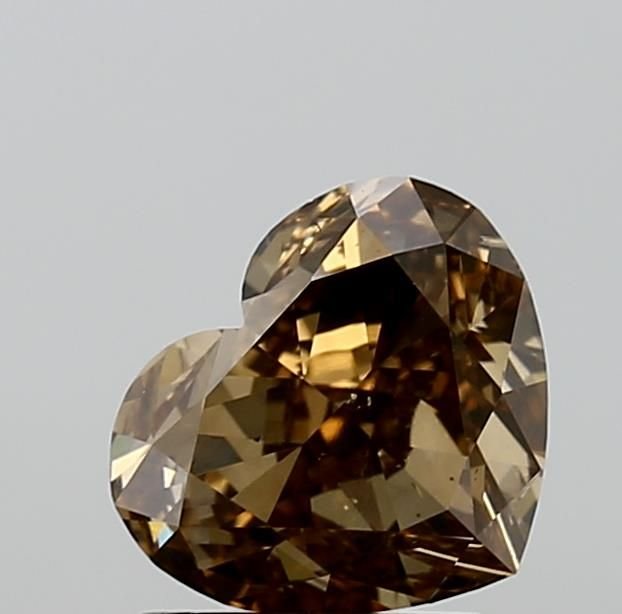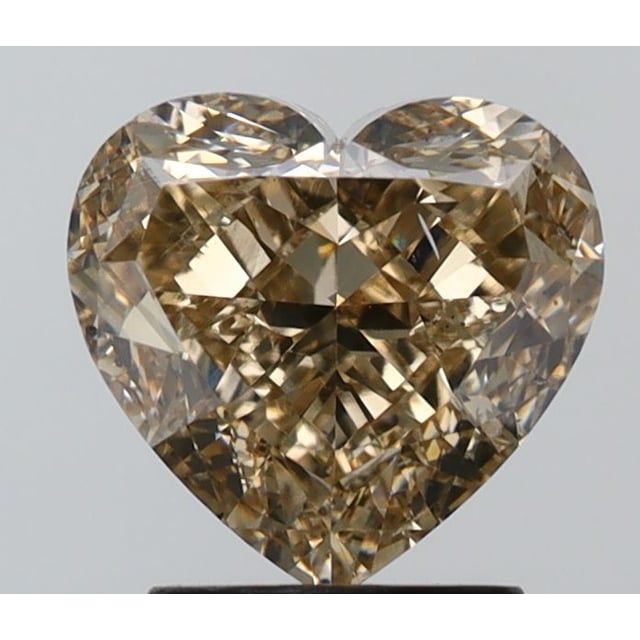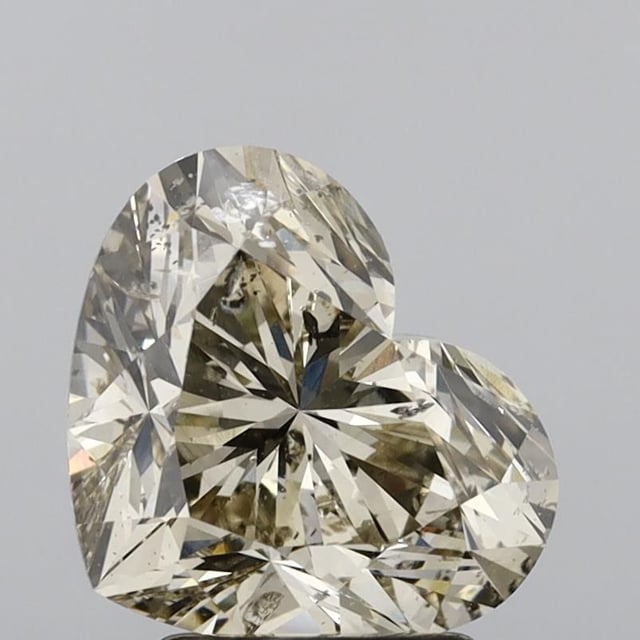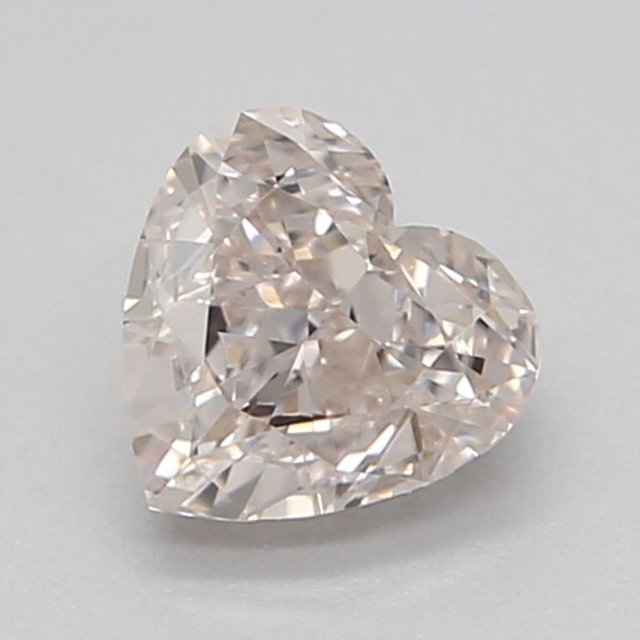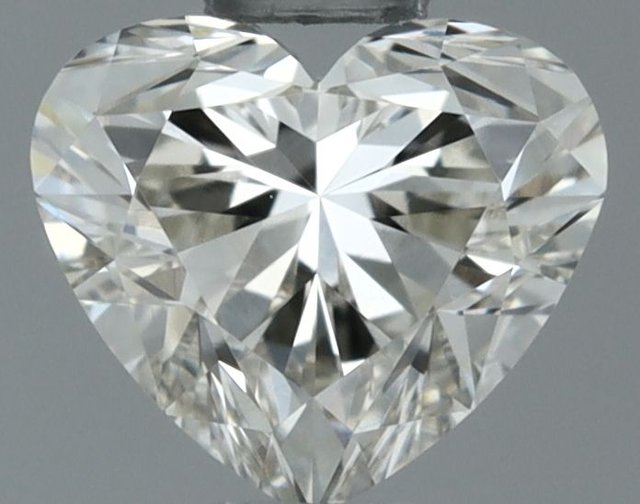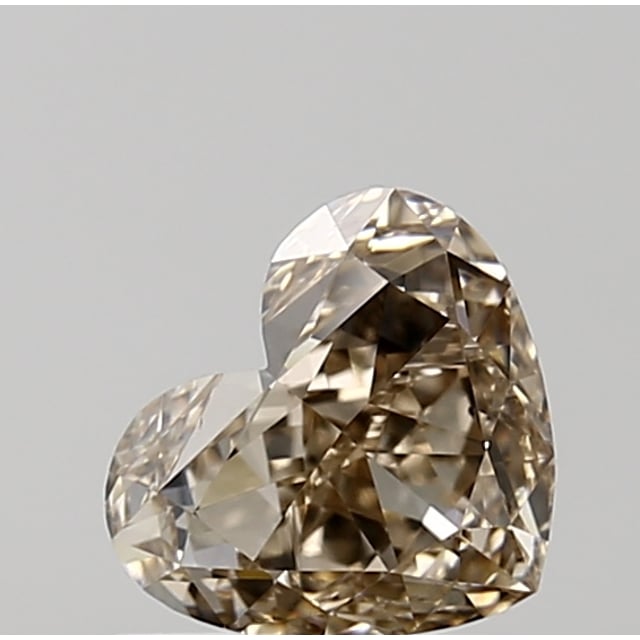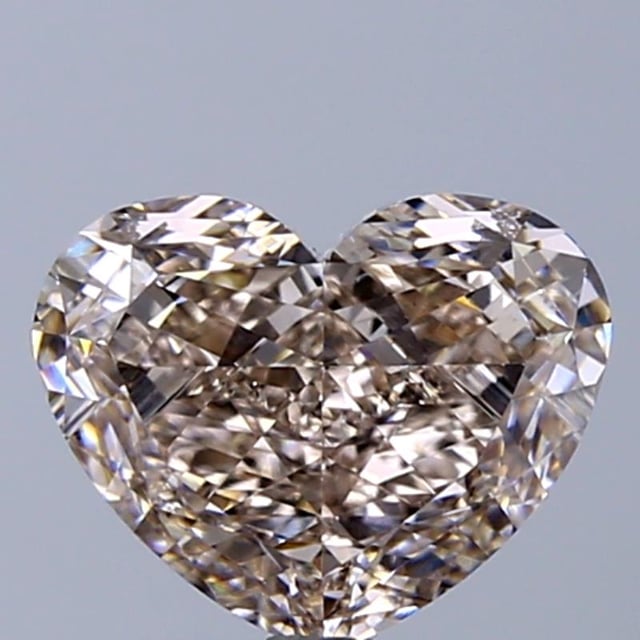
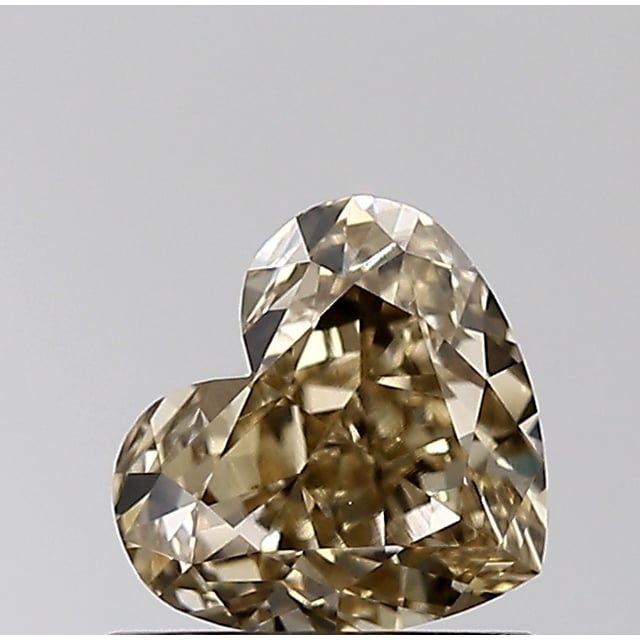
A heart is the shape where the outline does more work than the grade. It is a brilliant cut with a cleft at the top, two lobes and a point at the base, and none of those features is held to a graded standard — so two heart shaped diamonds of the same carat weight, color and clarity can read as different stones. For a champagne diamond that matters twice over: the warmth gathers where the outline returns light least evenly, at the point and around the lobes, and the outline is also what decides whether the stone reads as a heart at all from arm's length. You can browse every heart shaped champagne diamond indexed here while you compare.
It is a thin pool. There were 116 heart stones on the 2026-09-13 data snapshot, against 1,434 rounds and 333 pears, so this is a shape where you choose among the stones that exist rather than specifying a letter, a clarity and a carat weight and expecting to find the combination.
Champagne is a trade description rather than a laboratory term. A stone is admitted to this index only when GIA wrote a brown notation into the color grade line — Faint Brown, Very Light Brown or Light Brown beside a K-to-Z letter — or graded it on the fancy scale with brown as the dominant color, as in Fancy Brown. How we verify every stone sets out both rules and how to check any single diamond against its own report.
Where the tint sits in this outline
A heart uses brilliant faceting, the same family of kite and triangular facets as a round, arranged inside an outline that is closer to a pear than to anything else: a point at one end, a broad body, and a cleft cut into the opposite end to make two lobes. Brilliant faceting breaks returned light into many small flashes, and that scattering dilutes body color, so a heart does not state its warmth the way an emerald cut does.
What the outline does is redistribute it. Toward the point the facets get smaller and the stone narrows, and that end returns light less evenly than the wide middle, so tint reads strongest there. The same happens, less markedly, around the outer curve of each lobe. A pear concentrates color at one tip; a heart spreads the effect over a point and two shoulders, which is why the color pattern in a heart usually reads as a soft frame around a brighter center rather than as a single warm end.
It also means the report will not tell you what you are about to see: two hearts with the same grade can look quite different face-up depending on how long the point is drawn and how full the lobes are. Video will show it. How the other outlines handle the same tint is compared on the same data in best shapes for champagne diamonds, and what "faint brown" means covers how little of the notation shows face-up to begin with.
The cleft decides whether it reads as a heart
The cleft is the notch between the two lobes, and it is the single feature that makes the shape legible. A well-cut cleft is sharp, distinct and sits exactly on the vertical axis of the stone. A shallow or rounded one turns the outline into something closer to a cushion with an indentation, and no setting recovers it.
Three things are worth looking at, all visible in a good top-down image:
- Definition. The V should come to a clear meeting point rather than fading into a soft dip between the lobes.
- Position. It should sit on the line running down to the point, not off to one side.
- What the setting does to it. Most heart settings place a prong at the cleft, and a prong wide enough to hold the stone can fill a shallow cleft entirely. Ask to see the setting design against the actual stone rather than a rendering.
GIA does not grade the cleft. A fancy-shape report carries polish and symmetry grades, which describe finish and outline rather than light return, and GIA issues a cut grade for round brilliants only — so any cut label on a heart listing is the retailer's own judgment rather than a laboratory grade.
Symmetry, read before anything else
The eye reads the outline of a heart before it reads a single facet, and this is the least forgiving common shape for asymmetry. Four checks:
- The lobes match. Equal height, equal width, equal curve. One fuller lobe is the asymmetry people notice first.
- The two halves mirror. Fold the stone along the axis from cleft to point in your mind; the left and right sides should land on each other.
- The point is on the axis. A point that sits slightly off-center gives the whole outline a tilted look.
- The wings are smooth. The curve running from each lobe down to the point should have no flat spot where the two meet.
Length-to-width ratio is taste rather than quality and is not graded. Most heart cuts fall near a ratio of one, with wider stones reading fuller and rounder and narrower ones reading more slender. Because ratio changes face-up size as much as appearance, read the millimeter measurements on the listing rather than assuming that carat weight describes the size you will see on a hand.
The bow-tie sits in the belly
Like every brilliant cut with an elongated component, a heart can carry a bow-tie: a dark band across the width of the stone where the pavilion facets return the viewer's own shadow instead of light. It forms in the broad middle of the stone — the same region that is supposed to stay bright while the point and lobes hold the warmth.
A mild bow-tie is gray, soft-edged, and lifts as the stone tilts; most people read it as contrast. A severe one is black, hard-edged and static at every angle, and in a tinted stone it removes exactly the bright area the color pattern depends on. GIA does not grade bow-tie, so this is judged by eye: watch the 360-degree video full screen, and watch the middle third of the stone rather than the point.
Setting a heart, and the size it wants
The point is the thinnest, least supported part of the stone and takes a knock worse than the body does. The standard answer is a V-prong shaped to wrap the tip on both sides rather than pinch it from one, usually with prongs on the outer curve of each lobe and one at the cleft. Check girdle thickness at the point on the GIA report as well: an extremely thin girdle running out to a tip is more fragile than a medium one. A full bezel works against this shape more than most, because it rounds the outline and softens the cleft, which are the two things the heart is bought for.
Size follows from the same reasoning. A setting covers a few millimeters of girdle whatever the carat weight, so a small heart surrenders proportionally more of its outline to metal, and the cleft and lobes are the detail that gets lost. If the shape is the point of the ring, weight is what keeps it readable.
What a heart shaped champagne diamond costs
Price is set first by carat weight and then by the tint, and today's snapshot supports no heart-only median. The honest way to price the shape is to read the heart collection against the carat band you are shopping in, with champagne diamond prices for the band structure across all shapes and one carat and over for the band most buyers land in.
Two comparisons frame what the tint is worth, and they measure different things. The first sets a stone against a different diamond: every card here is priced against a similar near-colorless G–H stone matched on shape, clarity, cut grade and carat weight, taken at the lower quartile of current listings, and stones with a saving run a median 44 percent below that benchmark. It compares asking prices rather than completed sales, and a warm heart and a near-colorless one are never a perfect match, so it describes the size of the gap rather than a guaranteed discount. The method is set out on the prices page and in how our benchmark works.
The second is about the same stone. Because these listings come from nine retailers and are matched by GIA report number, one diamond is often listed by more than one store at different asking prices — why the same champagne diamond costs different amounts explains how that happens and how to use it.