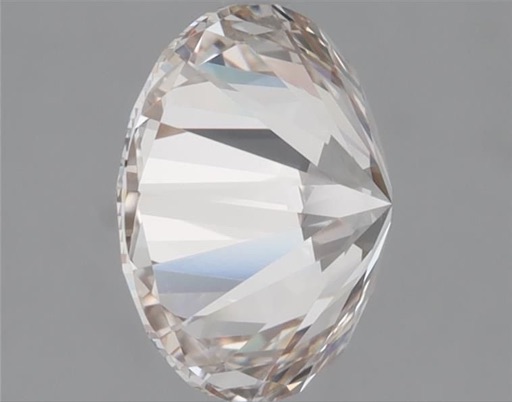
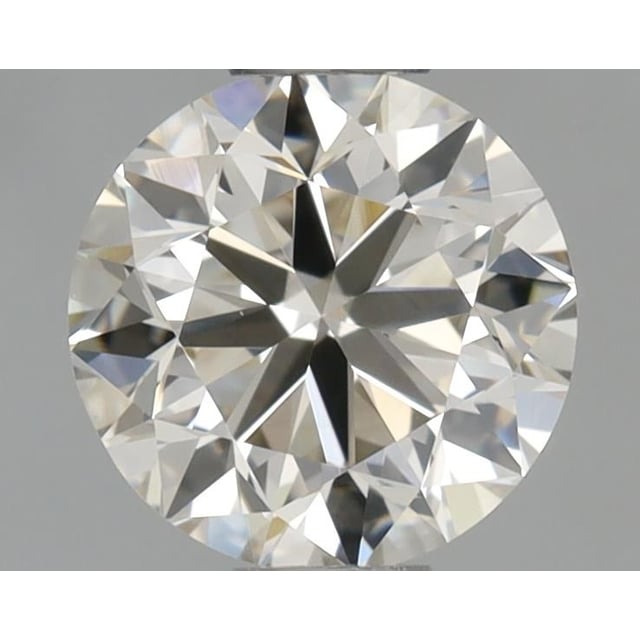
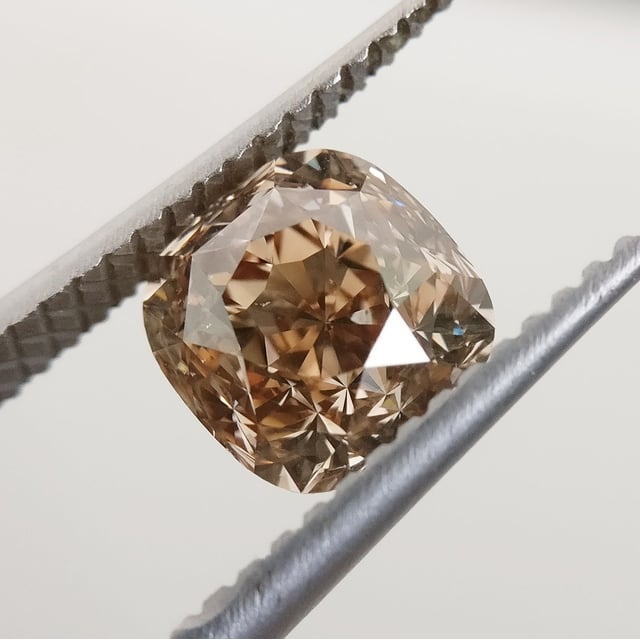
A champagne diamond is a natural diamond whose body color reads warm brown, sold under a trade name rather than a laboratory one. No grading report anywhere says champagne. What a GIA report says is one of two things: a color letter with a brown hue printed beside it, as in K, Faint Brown, or a colored-diamond grade in which brown is the dominant color, as in Fancy Brown. Both are sold as champagne, they are graded on scales that run in opposite directions, and they carry different prices.
That is the whole answer, and the rest of this guide is the detail a buyer needs to act on it: where the color comes from, what each kind of report actually says, what the C1-to-C7 charts circulating online are, whether treatment is a live question, and what these stones cost. champ. indexes natural champagne diamonds listed by other retailers, matches the same stone across sellers by its GIA report number, and links you to the seller; the numbers below come from that index on the 2026-09-17 data snapshot.
Where the brown comes from
The color is structural rather than added. Writing in GIA's Gems & Gemology in Spring 2023, Evan M. Smith describes plastic deformation — the crystal lattice slipping along internal planes under stress after the diamond has crystallized, during its residence in the mantle or its ascent to the surface — as one of the most prevalent features in natural diamond. Where dislocations interact they leave vacancies, gaps where a carbon atom should be, and clusters of roughly 40 to 60 of those vacancies are thought to be responsible for the common brown color in diamond. The color often concentrates along the slip planes themselves, which is why brown in a rough stone frequently appears as graining or banded lamellae rather than as an even wash.
Two consequences follow for a shopper. The first is that brown is ordinary at the rough stage: in the Winter 2018 Gems & Gemology survey of pink, purple, red and brown diamonds, Sally Eaton-Magaña and co-authors note that a brownish tinge is reported in 98 percent of as-mined diamonds, most of that material never reaching gem quality. The second is that the same lattice damage can be undone. Research into the cause of brown color intensified after 1999, when General Electric announced that high-pressure, high-temperature processing could decolorize brown diamonds commercially. The tint sold as champagne is the same feature the treatment industry exists to remove.
What the report says instead of champagne
GIA grades these stones through two separate systems, and which one a stone went through changes what you are buying.
On the D-to-Z scale, which grades how little color a diamond has, the letter comes first and the hue word follows it where the residual tint reads brown: Faint Brown at K to M, Very Light Brown further down, Light Brown further down again. These are near-colorless-to-faint stones with one extra word on the report, and that word is most of what moves the price. What "faint brown" means sets out how the notation is assigned and why retailer filters almost never show it.
On GIA's colored-diamond scale, which grades how much color a diamond has, there is no letter at all. The grade names the color and its intensity — Fancy Light Brown, Fancy Brown, Fancy Yellow Brown — and GIA writes the dominant color last, so Fancy Pink Brown is a brown diamond while Fancy Brown Pink is a pink one. Champagne, fancy brown and chocolate covers how those grades are assembled and where the trade names attach to them.
The split on this index is lopsided. Of the 2,715 unique natural brown stones live on the 2026-09-17 snapshot, 2,340 are white-scale stones carrying a notation — 2,210 Faint Brown, 115 Very Light Brown and 15 Light Brown — against 375 graded on the fancy scale, 324 Fancy Brown and 51 Fancy Light Brown. Most of what the market calls champagne is a lettered diamond with a hue word, not a fancy-color diamond.
The color chart question
Searches for a champagne diamond color chart usually land on a C1-to-C7 scale. It came from the Argyle mine in Australia, which produced brown diamonds in volume and, as the Natural Diamond Council's Jill Newman records, developed its own classification system running from C1, light champagne tones, to C7 or C8, deep cognac and chocolate hues.
Three things are worth knowing before using one of those charts. It is a producer and trade scale, not a laboratory one: it appears on no GIA report, so a stone cannot be checked against it the way a color grade can. There is no published conversion between the C numbers and GIA grades, and charts that assert one are asserting it, not citing it. And because application varies between sellers, the same stone can be called C3 by one and C4 by another. How the names champagne, cognac and chocolate arrived in the first place is the subject of our piece on four decades of renaming the same diamond.
Natural color, treated color, and which report tells you
Champagne diamonds are diamonds in every ordinary sense: same carbon, same hardness, same laboratories, same reports. The distinction that carries money is natural color against treated color, since brown can also be produced by irradiation and annealing, and removed by HPHT processing.
GIA answers the question on its colored-diamond reports, which state the origin of the color as natural or treated, naming the process where one is detected; the laboratory also declines to issue a colored-diamond grading report on a stone carrying an unstable treatment such as fracture filling or coating. On a D-to-Z report, any treatment detected is noted rather than being part of the color grade, so the comments line deserves as much attention as the color line.
A stone reaches this index by its report, not by a retailer's description: how we verify every stone sets out the two rules that admit one and how to check any stone yourself against GIA's own lookup. Screening for treatment is not among them, which is why reading the report for yourself remains the step that settles it.
What one costs
Size dominates the price far more than the depth of the tint does. On the 2026-09-17 snapshot the median asking price across the 2,715 stones indexed here was $1,413, with the range running from $97 to $242,850 — a spread produced mostly by carat weight, with clarity and cut behind it.
The tint's own effect shows up in two separate comparisons, and they measure different things. Setting a brown-notation stone against a stone of the same color letter and carat band with no notation isolates the word on the report. Setting it against a similar near-colorless G-H natural diamond, matched on shape, the same clarity, the same cut tier and a carat window that never crosses a trade threshold, prices the whole gap between a warm stone and a near-colorless one: on that basis 2,420 of the 2,715 stones were listed below their benchmark, by a median of 46 percent. Both figures are built from retailer asking prices rather than completed sales, and a warm stone and a near-colorless one are never a perfect match, so the number describes the size of a gap rather than money saved. The method sits on the prices page, and the cell-by-cell tables are in champagne diamond prices.
Comparing one before you buy
The last thing worth knowing about the category is that the same physical stone often appears in several places at once. Those 2,715 stones carried 5,004 retailer listings across nine retailers on the 2026-09-17 snapshot, and 1,182 of them were listed by more than one retailer — one diamond, one GIA report number, more than one asking price. Why the same champagne diamond costs different amounts at different retailers explains what produces those spreads and how to read them.
From there the practical route is by outline and depth of tint: round is much the largest group at 1,411 stones, and the Faint Brown and Fancy Brown pages divide the index the other way, by how much color the report records.







