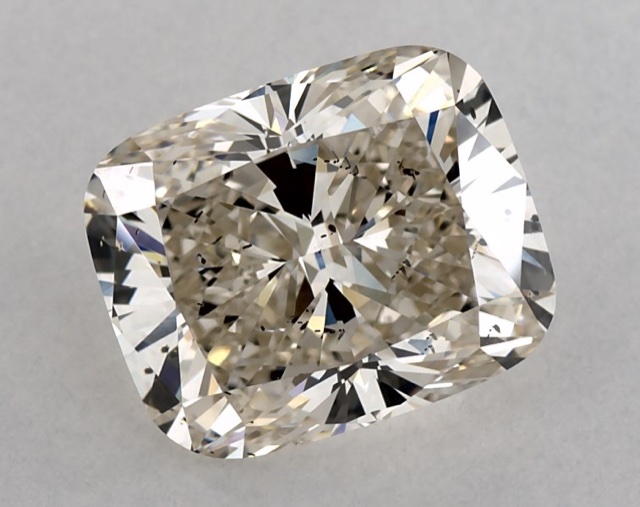
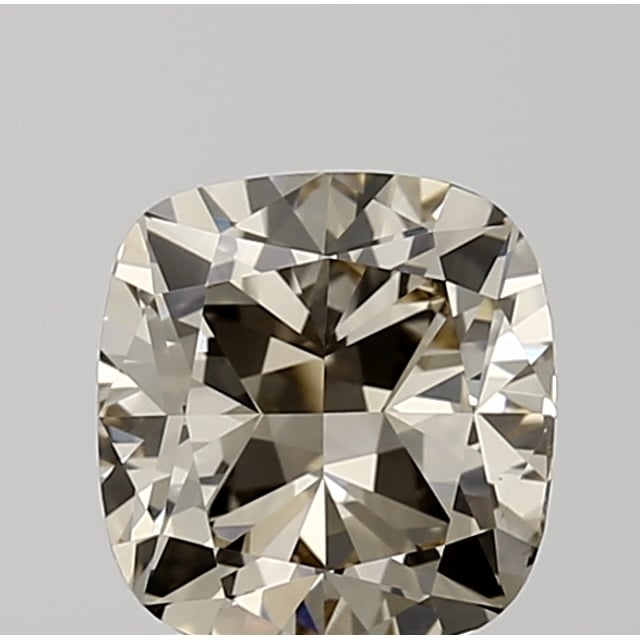
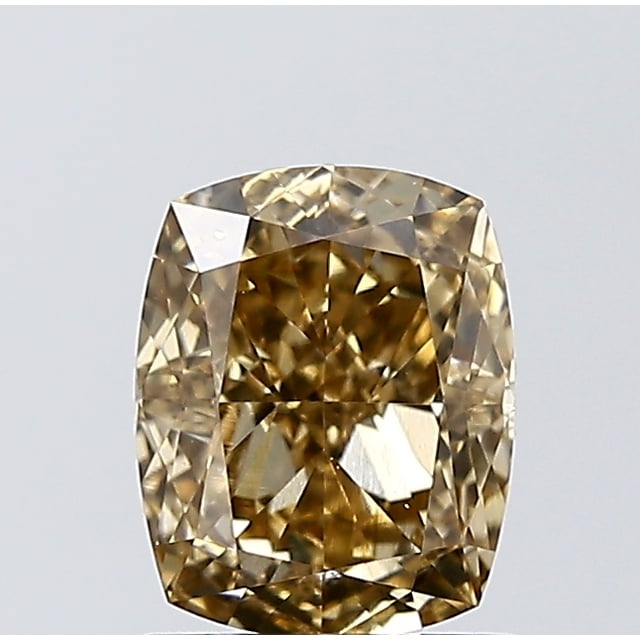
Three phrases circulate for what looks like the same stone: champagne, fancy brown, and chocolate. They are not interchangeable. They describe three grading situations, sold through three channels, at three prices.
A diamond with a warm brown cast can be graded on either of two scales. On the D-to-Z scale — the ordinary colorless-to-light scale used for white diamonds — brown is recorded as a notation appended to a letter grade, and it functions as a fault. The stone is priced down. On the fancy-color scale, brown is graded as a color in its own right, starting at Fancy Light Brown. The stone is no longer measured against colorless, so the white-scale discount has nothing to attach to.
Champ. Diamonds now indexes both kinds, but not on the same terms: 2,822 stones, of which 2,421 carry a color grade with a brown notation and 401 are graded on the fancy scale with brown as the dominant color. The fancy stones are here under a stated rule, and the rule is about price.
Two scales, one color
GIA grades a polished diamond on one scale or the other, never both. Which one applies depends on how saturated the color is.
A stone still recognizably within the colorless-to-light range gets a letter, D through Z. If it has a brown cast, the report carries that letter plus a notation: "Faint Brown", "Very Light Brown", "Light Brown". The letter is doing the work. The notation tells you which direction the tint runs, and the market reads it as a demerit against an otherwise white stone.
Push the saturation further and the stone leaves D-to-Z entirely. It is graded instead on the fancy-color scale, which for brown begins at Fancy Light Brown and continues through Fancy Brown. The GIA scale itself runs on into darker and deeper intensities beyond that, but this site stops at Fancy Brown, because past that point a stone reads as cognac rather than champagne. There is no letter any more. Brown has stopped being a contaminant of white and started being the point.
| D-to-Z with brown notation | Fancy-color scale | |
|---|---|---|
| How the report reads | Letter grade plus notation, e.g. K Faint Brown | Fancy Light Brown or Fancy Brown |
| What brown counts as | A deviation from colorless | The graded color itself |
| Effect on price | Discounted against the same letter with no notation | Priced as a colored diamond; no white-scale discount |
| Listed on this site | Yes, 2,421 stones | Yes, 401 stones, under the rule below |
Which fancy stones we admit, and why
A fancy-color stone is listed here only when three things hold at once.
First, brown has to be the dominant color. GIA writes the dominant color last in a fancy grade, so "Fancy Pink Brown" is a brown stone and qualifies, while "Fancy Brown Pink" is a pink stone and does not.
Second, the stone has to cost less per carat than the median untinted D-to-Z stone of the same carat band. A fancy brown priced above the white stones it would be bought instead of is a colored-diamond purchase rather than a discount purchase.
Third, the intensity has to stay within the two shallowest steps. Any grade containing "Dark" or "Deep" is excluded, because those stones read as cognac or near-black rather than champagne.
On the 3 September 2026 merge those conditions rejected 1,342 stones: 628 were not brown-dominant, 509 were not cheaper than the matching untinted median, 133 carried letterless colored-report grades that duplicate the white-scale wording, and 72 were too dark.
What survives is shallow-to-middling brown: 52 Fancy Light Brown and 349 Fancy Brown. Most are modified by a second hue: on that merge Fancy Yellow Brown led at 126 stones, then Fancy Yellowish Brown at 79, with unmodified Fancy Brown at 26. Leibish, the one fancy-color specialist among the retailers indexed, supplies 17 listings on the 17 October 2026 build, all fancy-scale.
Fancy stones carry no color letter, so the notation discount below does not apply to them.
What the notation discount is actually worth
The per-letter study covers D-to-Z stones only, and it measures the notation discount: stones matched on the same color letter and the same carat band, those with a brown notation against those without. On the 2 September 2026 study that gave eleven usable cells. Across them the discount ran from -14% to 31%, with a median of 20%. It is not the champagne discount, the struck-through figure on every card, which sets a stone against a similar near-colorless G–H diamond at the lower quartile of current listings and runs a median 44% among stones with a saving.
The negative cells are worth naming: at L color in the 0.50-0.99 ct band the brown stones were 1% more expensive per carat, and at M in the same band 14% more. Under a carat the tint is small, the samples are thinner, and the market largely stops pricing the notation. The discount then widens through 1.00-1.49 ct and reaches its widest from 1.50 ct upward, where every cell measured falls between 26% and 31%. The pricing guide sets out all eleven cells with their medians and sample counts; K, L, M and N color reads the same data letter by letter.
Three groups, same carat band
The comparison can also be run by carat band rather than by letter, which the fancy stones do not have, across all three groups. Median price per carat:
| Carat band | Fancy-scale browns | White-scale browns | No brown notation |
|---|---|---|---|
| 1.00-1.49 ct | $1,053 | $1,687 | $2,059 |
| 1.50-1.99 ct | $1,364 | $2,136 | $2,972 |
| 2.00-2.99 ct | $2,504 | $3,542 | $4,843 |
| 3.00 ct and over | $4,060 | $7,294 | $8,271 |
The ordering holds at every band from 1 carat up, and the gap widens with size. These medians were computed on the 3 September 2026 merge, before the darkest grades were dropped, so the fancy-scale column still counts the 31 stones since removed.
Read that table with the admission rule in mind. It does not show that fancy brown diamonds are cheap in general — the second condition guarantees that every fancy stone listed here undercuts the untinted median of its band. What it shows is the size of the effect once the filter has run, which is larger than the notation discount.
Where the champagne stones actually sit
Almost all of the D-to-Z stones sit at the shallow end of the notation: 2,269 Faint Brown, 134 Very Light Brown and 18 Light Brown. The typical stone in that group is a white diamond with a warm undertone, not a deep cognac color; the fancy listings are where the visibly brown stones now are.
The letters concentrate the same way — 1,348 K, 559 L, 251 M and 129 N — a range many buyers already shop for the price break, notation or not. The notation discount comes on top of that letter break. For how it reads on a report, see what a Faint Brown notation means.
Chocolate diamonds are a different product
Chocolate Diamonds® is a registered trademark of Le Vian, applied to brown diamonds that meet the house's own internal selection standards. It is not the same purchase as a loose stone bought off a report, and it is only the most recent of several names the trade has given this color — the sequence is traced in cape, champagne, chocolate, desert.
Three things separate it from what this site indexes. Part of the price is the brand, as with any named jewelry line. The stones are generally sold already set, so you are buying a design and a setting alongside the diamond. And the color sits in the deeper, saturated range that reads as brown to the eye, a different look from a K Faint Brown.
Because it reaches the buyer as a branded finished good rather than a loose GIA-graded stone, we hold no data on it and offer no price comparison. Champagne, by contrast, is owned by nobody — a descriptive word anyone can apply to any warm stone, which is why we index the GIA report wording rather than the marketing word.
Shopping across the boundary
Within the D-to-Z group, compare on the letter and the notation together rather than either alone. A K Faint Brown and a K with no notation carry the same letter and sit at different prices, so a search filtered only to K puts both in front of you without distinguishing them. The notation is the part that moves the number.
Both effects reward size, so they are most useful at 1 carat and above. At K 2.00-2.99 ct the D-to-Z medians are $3,874 and $5,470 per carat, a gap of $1,596; at K 0.50-0.99 ct, $1,095 against $1,354, a gap of $259. The percentage matters less than what it is a percentage of.
Every stone here, on either scale, has had its report read directly rather than taken from a listing description, which is how the notation and the fancy grade are confirmed; the verification method sets it out.







