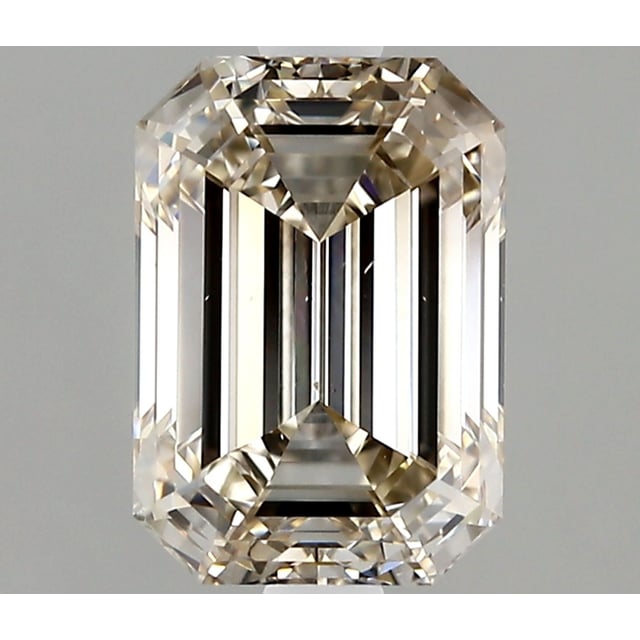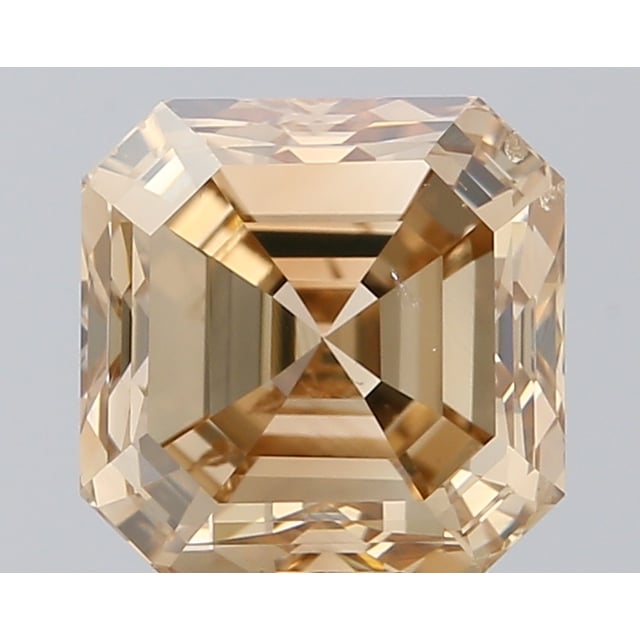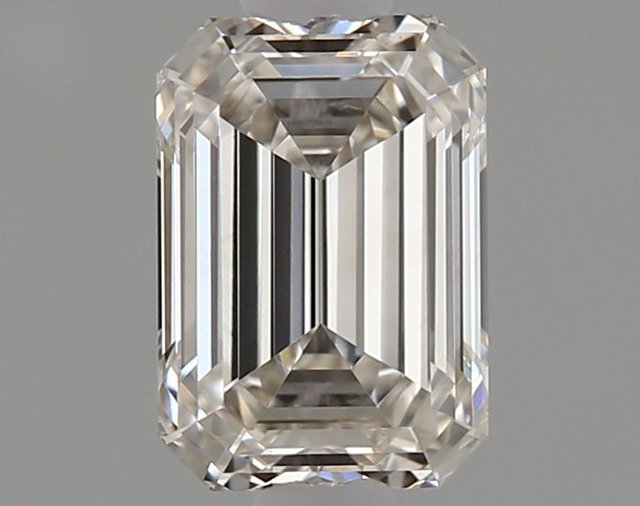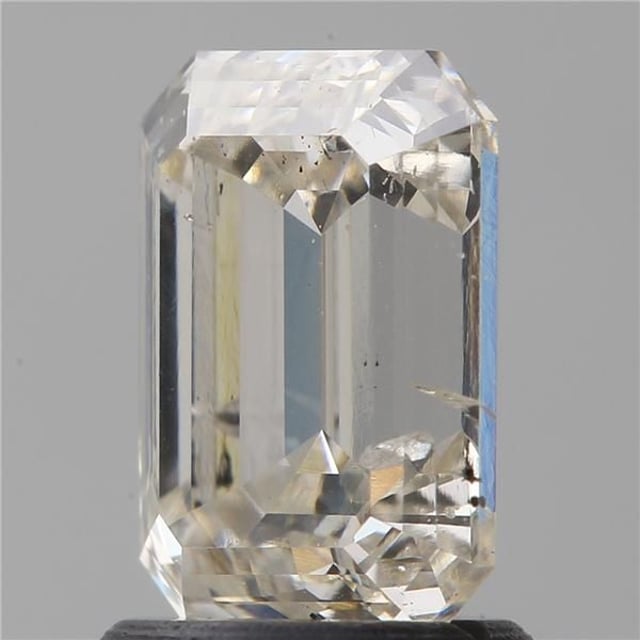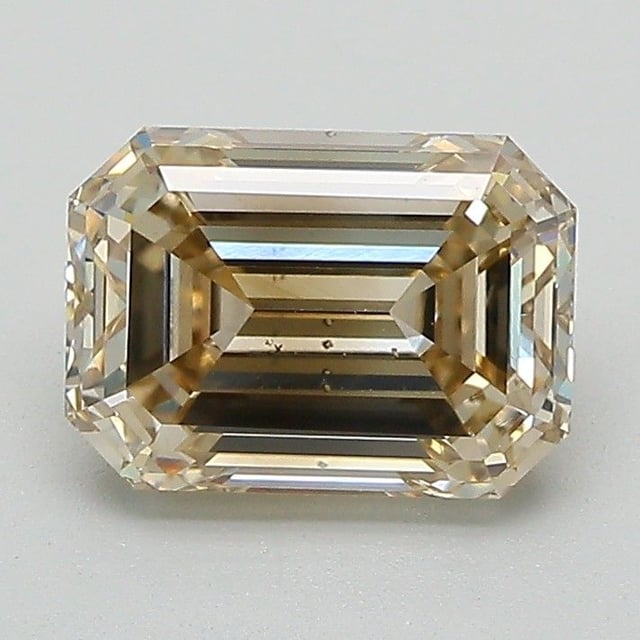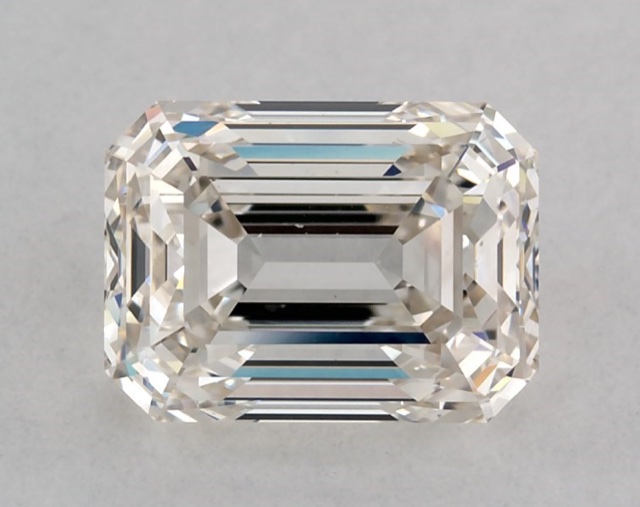
An emerald cut is the shape where a champagne tint stops being a technicality and becomes something you can see. The step-cut facets return light in broad, flat flashes rather than the scattered sparkle of a brilliant, so body color reads continuously across the table instead of being chopped up and hidden. If you want a faint brown to be visible and deliberate rather than a grading footnote, this is the shape that does it — you can browse all emerald cut champagne diamonds in one list.
There are 104 emerald cuts in the index of 2,822 stones, at a median price of $2,395 on the 17 October 2026 build. That median is the third highest of any shape, and the size skew of the pool is a large part of why.
The shape is scarce in this niche, and what does reach the index leans large. That is worth holding onto when you compare its median with the round's: you are comparing a mostly-over-a-carat pool with one that runs the full range of weights.
Why a step cut shows color honestly
A round brilliant is engineered to bounce light back at the eye in hundreds of small returns. That scintillation is very good at masking body color, which is why a K round often reads far whiter than its grade suggests, especially face-up, and why rounds dominate this index at 1,452 stones.
An emerald cut does the opposite. Its long parallel facets act more like a series of mirrors than a disco ball. Light travels further through the stone before it comes back, and what comes back arrives in wide planes. Warmth in the body of the diamond shows up as an even wash rather than a glint.
For a faint brown stone, that produces a specific look: a soft, dry, slightly smoky tone that holds steady as the stone moves, rather than flashing warm and then disappearing. It makes the emerald cut a sensible pick if you want the tint visible by design rather than tolerated. If you want the opposite effect, what faint brown means covers how the same grade behaves in brilliant-cut shapes.
The same logic applies to the Asscher, a square step cut and the only other step cut with its own page here, at 34 stones. How the other outlines handle the same tint is set out in best shapes for champagne diamonds.
What the numbers say about the shape
Here is the emerald cut alongside the shapes it is usually compared with, on the 17 October 2026 build. The counts cover both scales together, the D-to-Z stones and the fancy-color ones.
| Shape | Stones | Median price |
|---|---|---|
| Emerald | 104 | $2,395 |
| Asscher | 34 | $2,602 |
| Princess | 25 | $2,591 |
| Cushion | 183 | $1,660 |
| Radiant | 81 | $1,551 |
| Round | 1,452 | $1,069 |
The $2,395 median price is the third highest of the shapes with a page on this site, behind asscher at $2,602 and princess at $2,591 — and those two are the smallest pools here, at 34 and 25 stones. Among shapes stocked in any depth, the emerald cut is the dearest thing on the index.
Compare it with the round's $1,069 and the gap is more than twofold. Most of that distance is carat weight rather than facet style: the emerald pool skews large and the round pool does not.
How much of the price is size
Price rises steeply with size across the whole index, which is why a shape that skews large also skews expensive. The median runs $290 under half a carat, $720 in the 0.50-0.99 ct band, $1,664 at 1.00-1.49 ct, $3,136 at 1.50-1.99 ct, $6,865 at 2.00-2.99 ct and $21,470 at three carats and over; the full set of bands is in the price guide.
The emerald cut's median lands well inside the bands where cost climbs. If you are shopping the 1.00-1.49 ct band, an emerald cut is well supplied relative to its total count. If you want something under a carat, expect thin choice: the sub-carat end of this shape is sparse.
There is a practical qualifier to all of this. Emerald cuts are often cut for spread, so a well-proportioned one can face up larger than its weight suggests. That varies stone to stone, though, since a step cut can just as easily be cut deep, so read the millimeter dimensions on the listing rather than trusting the carat figure to describe the size you will see.
Clarity shows more, so read the report
The same optical honesty that reveals color also reveals inclusions. A step cut has nowhere to hide a feather or a crystal near the table. Brilliant facets break up an inclusion visually; step facets frame it.
Across the D-to-Z brown stones read for the 2 September 2026 study, the clarity spread ran like this: SI1 354, SI2 349, VS2 319, VS1 304, VVS1 265, VVS2 223, I1 70, IF 57, I2 13, I3 2. The two most common grades are SI1 and SI2, which in a round can often pass as eye-clean and in an emerald cut are less likely to.
That does not mean an SI emerald cut is a bad stone. It means the grade alone is a weaker signal in this shape, and the plot on the GIA report plus the retailer's own magnified images do more work. Inclusions sitting under the pavilion or near a corner behave very differently from one placed centrally beneath the table.
For emerald cuts specifically, it is worth being stricter than you would be with a round, and considering VS2 or better in a step cut, where an SI1 that would read eye-clean in a brilliant may not.
Color letters and brown depth
The brown notation itself comes in three depths across the D-to-Z side of the index: Faint Brown 2,269 stones, Very Light Brown 134 and Light Brown 18. The overwhelming majority of what you will see in an emerald cut listing is faint brown, the lightest of the brown comments GIA adds to a D-to-Z report.
By letter, the D-to-Z side of the index is dominated by four grades: K 1,348, L 559, M 251 and N 129, with a handful of outliers beyond them. In a brilliant cut, the practical difference between a K and an M is often small at arm's length. In an emerald cut it is not: each step down the letter scale is visible as a deeper wash of warmth, because the shape is not fighting you.
That makes the shape unusually good for matching intent to grade. If you want a barely-there warmth, a K faint brown emerald cut delivers it visibly but gently. If you want the warmth to be unmistakable, an M or N in this shape shows it plainly. These are all D-to-Z grades carrying a brown notation on the report. The index also holds 401 stones graded on GIA's separate fancy color scale, which carry no color letter at all: champagne vs fancy brown explains how the two scales differ. That scale has two steps here, 52 fancy light brown stones and 349 fancy brown ones. GIA's own scale continues past Fancy Brown into deeper, darker grades, but this site stops at Fancy Brown, because those darker stones read as cognac or near-black rather than champagne.
Against non-brown stones of the same color letter and carat band — the notation discount — the gap on the D-to-Z side ran from -14% to 31% across the eleven matched cells of the 2 September 2026 study, with a median of 20%. It widens with weight, holding between 26% and 31% in every cell at 1.50 ct and over, and becomes unreliable below one carat, where two cells price the brown stones higher instead, by 1% and 14%. That study covers lettered stones only, since a fancy-scale stone has no letter to match against. It is also the narrower of the two savings figures here: the champagne discount, struck through on every card, sets a stone against a similar near-colorless G–H diamond at the lower quartile of current listings and runs a median 44% among stones with a saving. Champagne diamond prices sets out both.