Set a lab-grown champagne diamond beside a natural one and the argument is rarely about how they look. Four other things separate them: where the brown came from, which laboratory graded the stone and what its report is allowed to say, whether the asking price can be checked against anything, and what happens if the owner wants to hand it back one day.
champ. indexes natural champagne diamonds and the rings made with them, and does not list lab-grown stones. That is a scope decision with a documented reason, set out below, rather than a comment on anyone's purchase. What follows compares the two on each of those four points, using the grading laboratories' own published work, and ends with what a given budget reaches in a natural stone on this index.
| Natural champagne diamond | Lab-grown champagne diamond | |
|---|---|---|
| Source of the brown | Plastic deformation in the earth, tied to vacancy clusters in the lattice | A growth byproduct in CVD material, or color arranged by post-growth annealing |
| Usual report | GIA, brown notation beside a K-to-Z grade, or a fancy grade with brown dominant | IGI, with growth method and treatment noted in the comments |
| Color grade available from GIA since 1 October 2025 | The full D-to-Z scale, with notations | None: a quality assessment reaching only to J color |
| Same stone comparable across sellers | Yes, matched by GIA report number | Rarely: stones are produced to specification |
| Price direction | Asking prices here, unchanged in method since the index began | A published wholesale index down 13% year on year in Q2 2026 |
| Trade-in and buyback | Widely accepted, terms vary by jeweler | Often declined, or restricted to a lab-grown upgrade |
Where the brown came from
The two browns have different biographies, and that is the part a photograph cannot show.
In a natural diamond, brown is a record of pressure. GIA researcher Evan M. Smith, writing in the Spring 2023 Gems & Gemology, describes vacancy clusters of roughly 40 to 60 missing atoms as what is thought to be responsible for the common brown color in diamond, formed when the crystal was plastically deformed deep in the earth. Most mined diamonds carry at least some brown from that process, from barely perceptible to obvious. A champagne tint is the visible end of something nearly universal.
In lab production, brown is mostly a chemical vapor deposition story, and mostly unwanted. GIA's Summer 2024 review of laboratory-grown diamonds submitted to its laboratories attributes brownish tones in as-grown CVD material to the presence of "vacancy clusters and/or nitrogen-related defects", and reports that approximately 80 percent of the CVD diamonds submitted to GIA since 2020 had been through post-growth processing — HPHT or LPHT annealing — which is used to reduce or shift brown toward the colorless range the market pays most for.
So a stone sold as lab-grown champagne is brown that was left in, brown that survived an attempt at removal, or color arranged afterward. IGI reports have stated growth method and addressed post-growth treatment since January 2021, and the FTC Jewelry Guides require laboratory origin to be disclosed clearly and conspicuously wherever the word diamond appears. The comments line on the report is where a buyer gets an answer; a listing that says only champagne gives none. Lab-grown champagne diamonds goes through that reading in more detail.
What the report can say
This is where the practical gap widened recently.
On 1 October 2025 GIA stopped issuing 4Cs color and clarity grades for D-to-Z laboratory-grown diamonds, replacing them with a Laboratory-Grown Diamond Quality Assessment carrying two descriptors, premium and standard. GIA president and chief executive Pritesh Patel said at the announcement that using descriptive terms for the quality of laboratory-grown diamonds is appropriate as most fall into a very narrow range of color and clarity.
For this subject the consequence is exact. A natural stone enters this index on its GIA report: a brown notation printed beside a K-to-Z color grade, as on the Faint Brown stones here, or a fancy grade with brown as the dominant color, as on the Fancy Brown ones. GIA's lab-grown assessment stops at J color and prints no color grade, so that notation cannot exist on a D-to-Z lab-grown report. What "faint brown" means explains what the notation does to a natural stone's price, and how we verify every stone sets out the two admission rules and how to check a single diamond against its own report.
Whether the price can be compared to anything
A price on its own is not information. What makes an asking price checkable is a second price for the same thing.
That is possible on the natural side. On the 2026-09-15 data snapshot this site held 2,666 unique verified natural brown stones across 4,920 retailer listings at nine retailers, and 1,144 of those stones were listed by more than one retailer — the same physical diamond, matched by GIA report number, with the spread visible. Why the same diamond costs different amounts works through why those gaps open. Every stone also carries a comparison against a similar near-colorless G–H natural diamond matched on shape, the same clarity and the same cut tier, within a carat window that never crosses a trade threshold, taken at the lower quartile of matched listings. On that snapshot, 2,374 of the 2,666 stones were priced below their benchmark, by a median of 46 percent. These are retailer asking prices rather than records of completed sales, and a warm stone and a near-colorless one are never a perfect match, so the benchmark measures the size of a gap, not a guaranteed saving. The method is on the prices page and in how our benchmark works.
Neither half of that exists for lab-grown stones. They are grown to specification in quantity, so two listings with identical specifications are usually different stones and the matched comparison has nothing to bite on. And the reference point keeps moving: Edahn Golan's lab-grown wholesale price list, published 7 July 2026, put prices down 13 percent year on year in the second quarter of 2026 and 96 percent since tracking began in July 2018.
What happens when someone wants to hand it back
Jewelers have answered this in the trade press and in their own published terms. JCK asked retailers in December 2023 how they handle lab-grown trade-ins; several said plainly that they do not accept them, one requiring customers to sign an acknowledgement of that at the point of sale, while others apply the same terms they use on natural stones. The pattern in the large chains is an asymmetry rather than a refusal: Jared's published trade-in terms, checked on 16 September 2026, allow natural diamond jewelry to be upgraded toward either a natural or a lab-grown piece, while lab-grown jewelry can be upgraded only toward another lab-grown piece, in both cases against something at least double the trade-in amount.
Read that as a policy fact rather than a forecast. It is one more reason to treat a diamond of either origin as jewelry.
What the same budget reaches in a natural stone
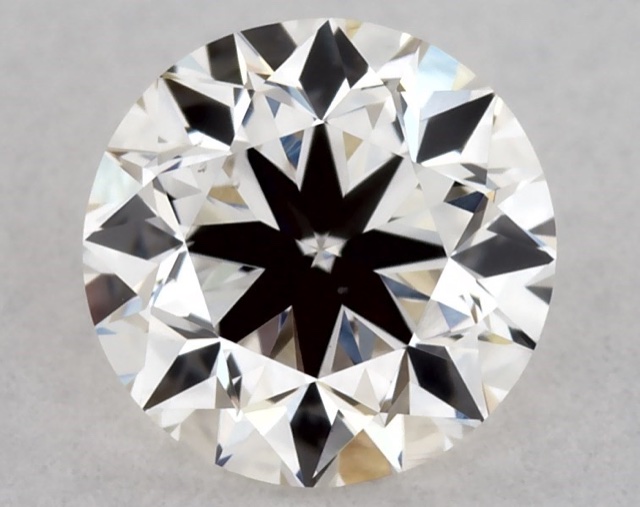
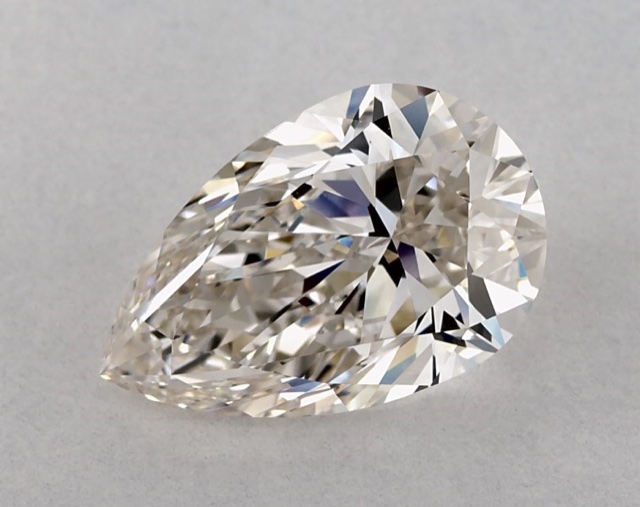
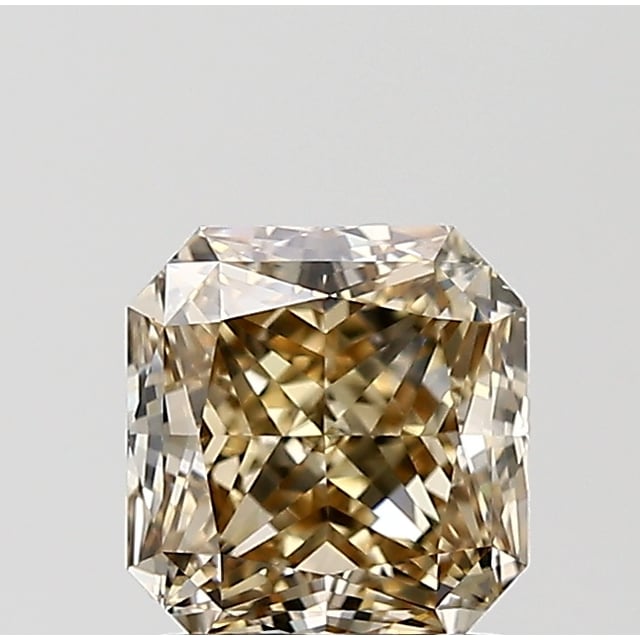
Natural champagne is not a tier above the lab-grown one. It is the corner of the natural market where the trade's preference for colorlessness works in a buyer's favor, which is why the numbers above start where they do: a median asking price of $1,435 on the 2026-09-15 snapshot and a range running from $70 to $224,546. A three-figure budget buys a small natural stone here, and a low four-figure budget sits above the midpoint of the entire index rather than at its edge. The stones pictured above are live listings at three sizes with their asking prices attached.
They are loose diamonds, and a loose stone is not a ring. Read loose against loose and finished against finished: the natural champagne rings indexed here are complete pieces with the setting included, while anything in the figure above still needs one.







