
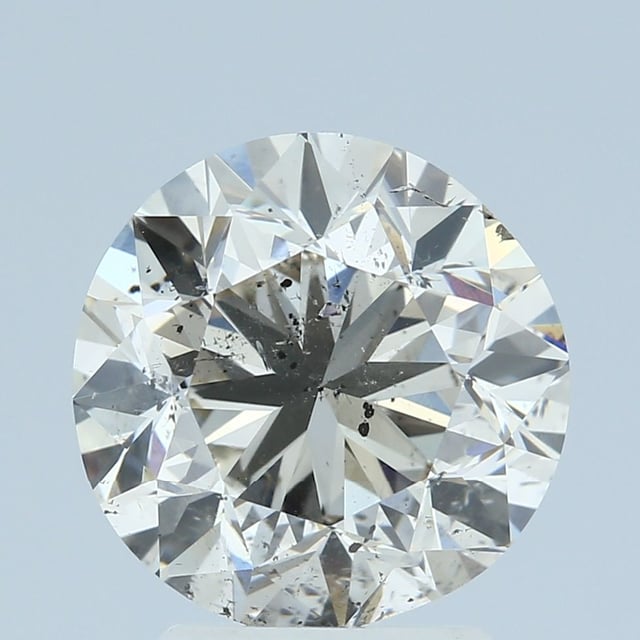
Lab-grown diamond wholesale prices went up in the third quarter of 2026. Edahn Golan published his quarterly wholesale price list on 7 October under the question "Was the Bottom Reached?", with round stones between one and three carats about 2% dearer than in the second quarter. He does not oversell it: "The recovery is not broad-based, and year-over-year pricing remains significantly below prior levels." Twelve months earlier the same list fell 9% on the quarter.
champ. does not list lab-grown stones. This index covers natural champagne diamonds and natural champagne diamond rings, admitted on the text of their GIA reports. The lab price list matters here anyway, because for a large share of the people reading a champagne diamond listing the alternative on the other browser tab is a lab-grown stone, and its price has been the one moving.
What the list reports
Quarter on quarter, Q3 2026 against Q2 2026, from the 7 October list:
| Category | Change on the quarter |
|---|---|
| Round, 1 to 3 ct, overall | +2% |
| 1 ct rounds | +1.3% |
| 2 ct rounds | +2.3% |
| 3 ct rounds | +7.5% |
| 1.50 ct category | −3% |
| Fancy and square shapes | +7.5% |
Against the same quarter of 2025 the picture is the opposite one: rounds down 9%, 2-carat rounds down 20%, fancy shapes down 9.5%, square shapes modestly higher, and the LGD Wholesale Price Index down 15%. Golan puts that index 93% below where his tracking started in July 2018. As in the natural trade, "fancy" in those lines means fancy shapes — pears, ovals, emerald cuts — and not fancy-color grades.
One quarter in one analyst's list is the whole of the evidence here. These are his published wholesale figures rather than a trade-wide index, and no trade-press coverage of the Q3 list had appeared in the outlets we checked on 9 October. His own framing is conditional: "if the recent gains are sustained, they could mark an inflection point in the lab-grown diamond wholesale price cycle."
Wholesale, per carat, and how small the numbers are
The Q3 list prices round IGI-graded lab-grown stones between $73 and $142 per carat. The top of that range is a 3-carat D-color VVS stone; G–H colors sit at $73 to $79 per carat across all sizes. Those are prices asked between traders for unmounted stones, not retail tickets: a finished lab-grown ring adds the setting, the retailer's margin and whatever promotion is running.
The scale of the move is easier to read against where the list began. Golan's statistics page, updated in August 2026, puts the mid-2018 wholesale average at $1,800 per carat for a one-carat lab-grown diamond and above $3,000 per carat for a two-carat stone; by mid-2026 the same stones traded at about $80 and $85 per carat, a fall of more than 97% over seven years. A 2% quarter sits on top of that.
Three guides here cite the previous list, published 7 July 2026, and read it as a price still falling — that list had wholesale prices down 13% year on year. On the round categories this quarter the direction reversed. That is a correction worth making in our own voice rather than leaving in place.
The other list that moved, and what neither one reaches
Rapaport reported on 6 October that natural prices kept recovering in September: its index rose 3.2% at 0.30 ct, 2.5% at 0.50 ct, 0.3% at 1 ct and 1.5% at 3 ct, leaving the 0.30-carat index up 15.1% for the year to date. Rounds "again outperformed fancy shapes", and "smaller, lower-quality diamonds stayed under pressure from lab-grown competition" — a statement about the market as a whole rather than about any brown stone.
Neither list reaches the stones indexed here. Rapaport's index covers round, D-to-H, IF-to-VS2 goods, and the lab list is quoted in near-colorless letters, with a D-color stone at the top of its range and G–H at the bottom. The white-scale stones on this site start at K, three letters below H, each with a brown notation printed beside the letter, and what "faint brown" means covers how that notation is assigned. The fancy-scale browns carry no letter at all. Where the natural report does touch a champagne diamond's price is the struck-through figure on every card, which is built from live near-colorless G–H listings matched on shape, the same clarity, the same cut tier and a carat window that never crosses a trade threshold, taken at the lower quartile; G and H sit inside Rapaport's window. That link, and its limits, are set out on the prices page and in the earlier piece on Rapaport's index and champagne diamonds.
What our index shows — data snapshot 2026-10-09
2,814 unique verified natural brown diamonds, deduplicated by GIA report number, across 5,081 retailer listings at 9 retailers, with 1,223 stones listed at more than one retailer. By GIA wording: 2,265 Faint Brown, 131 Very Light Brown, 18 Light Brown, 348 Fancy Brown, 52 Fancy Light Brown. Median asking price $1,435, range $92 to $242,530. 2,440 stones sit below their matched near-colorless G–H benchmark, at a median discount of 45%. Retailer asking prices on one snapshot, not records of completed sales — and one snapshot cannot show a trend.
What it changes for the decision
Very little on price, which is the honest answer. A choice between a lab-grown stone and a natural champagne diamond was never going to be settled by two percentage points in a quarter, in wholesale figures, for stones in colors neither buyer is looking at. It turns on what the stone is and what can be checked about it: which laboratory graded it, whether the color is as-grown, treated or natural, and whether anyone else is offering the same stone at a different price. Those comparisons are worked through in lab-grown vs natural champagne diamonds and, at a fixed budget, in what the same money buys.
Two things the list does settle. There is still no published reference price for a lab-grown brown or champagne stone: the Q3 list carries no brown line at all, so a lab stone sold as champagne has nothing in it to be priced against. And a falling reference price was one of the arguments against buying lab-grown; for one quarter, on the round categories, that argument is weaker than it was. Neither of those makes a lab-grown stone comparable the way a natural one is, because lab stones are grown to specification in quantity and two listings with identical specifications are usually two different stones.
On the natural side the comparison that does not need a view on the cycle is the one with two prices on it. Of the 2,814 stones on the 2026-10-09 snapshot, 1,223 are listed by more than one retailer — the same physical diamond, matched by GIA report number, at more than one asking price, which is the subject of why the same champagne diamond costs different amounts. The largest pool to look at is round, and finished natural champagne rings from independent jewelers sit in the rings section.
What would make this a trend
Two or three more quarters in the same direction, confirmed by a second published index, and a buyer could reasonably talk about a floor in lab-grown prices. One quarter, in one list, not broad-based by its author's own description, is a data point. The figures above are what was published; the arc from $1,800 per carat to about $80 is what they are moving against.