Champagne diamonds now appear in almost every red-carpet round-up. Some of those sightings are documented down to the carat. Others rest on less than the repetition suggests. We went back to the outlet that first reported each one.
Well documented
Kate Hudson, 2026 Actor Awards. The best-sourced example by some distance. Marie Claire's Meguire Hennes reported a bespoke Emily P. Wheeler suite worth "a half million-dollar", with Hudson wearing over 20 carats. The specifics are unusually precise: a torque collar centred on a 10.15-carat antique stone the piece calls a champagne-coloured scene-stealer, ringed by 38.73 carats of white pavé; bubble-fringe earrings with 2.7-carat light brown stones; and rings of 3.09 and 2.71 carats that the designer sourced from Botswana.
Rose Byrne, 2026 Oscars. Galerie's Amy Elliott reported a Taffin de Givenchy necklace built around a 22.58-carat yellow-brown antique-cut diamond, and used it to argue that warm stones were behind some of the season's most talked-about jewels.
Worth noting on both: the house term used is "desert diamond", the marketing name discussed in our piece on the De Beers campaign. It is a brand phrase, not a grading term. No GIA colour grade is published for any of these stones, so "champagne" here is a description, not a GIA grading report.
Less documented than the repetition suggests
Scarlett Johansson, 2019. This is the anchor example in most brown-diamond explainers, including the Natural Diamond Council's, which describes an 11-carat oval brown Taffin ring designed by James de Givenchy. Go back to TODAY's original report and the colour is there — it calls it a "pale-brown diamond" — but the designer is not confirmed. TODAY says only that it "appears to be the work of Taffin Jewelry's James de Givenchy", inferring it from a matching ring the brand had posted on Instagram, and quotes Marion Fasel of The Adventurine conditionally. A hedge in 2019 has hardened into a fact by 2026.
Anna Sitar, 2026. This one is worth following carefully, because it shows how a trend claim gets made. E! News reported the engagement on 22 April 2026 and described the ring as a pear-shaped diamond. No colour. Two weeks later, on 7 May, a retailer blog stated that the engagement "sparked major interest in champagne-colored diamonds", crediting a warm-toned pear-shaped centre stone.
We are not saying the stone is not champagne — we have no idea, and neither, on the published record, does anyone else. What we can say is that the colour claim does not appear in the reporting of the engagement. It first appears in a jeweller's blog post two weeks later, and has been repeated from there.
What the look actually costs
Trend pieces rarely put a number on any of this, so here is ours.
The price of the pear, 4 September 2026
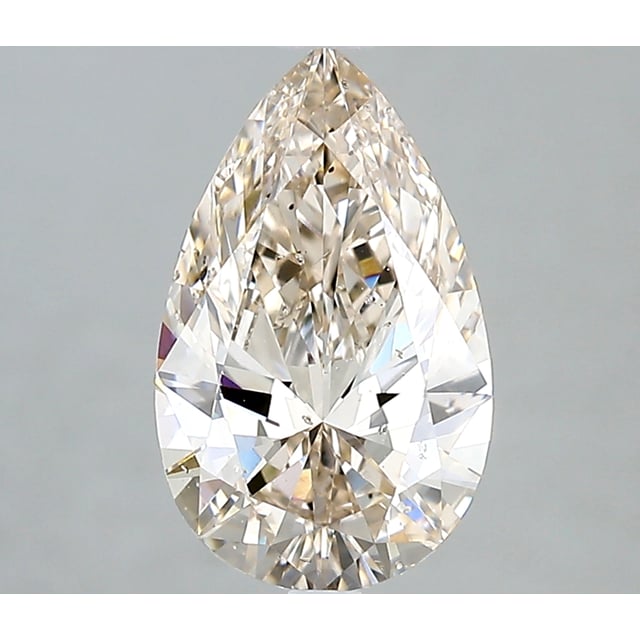
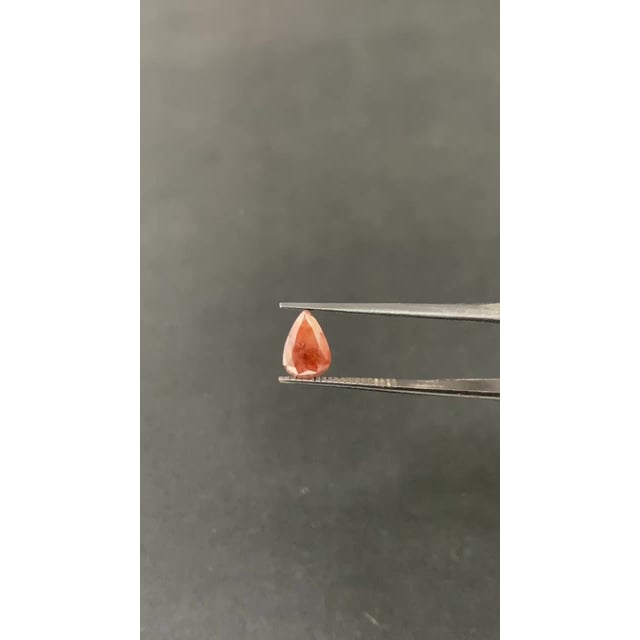
The warm-toned pear is the shape driving most of this coverage. Our index holds 294 pear-shaped champagne diamonds, running from $297 to $160,525, with a median of $1,946.
Narrow it to the celebrity proportion — one carat and up — and there are 187 stones, median $2,882, with the cheapest at $811 for a 1.00 ct Faint Brown.
Here is the part we did not expect. Pear carries no trend premium at all. At matched size, pears run 3% below rounds per carat at 0.90–1.10 ct, and 2% above at 1.40–1.70 ct. Whatever the red carpet has done for the shape's visibility, it has not moved its price against the most conventional cut there is.
That is the useful thing about running a price index alongside the coverage. A trend piece can tell you a colour is fashionable. It takes the listings to tell you whether fashionable has started costing more — and here, so far, it has not.
Browse the pear-shaped stones or read the pear champagne diamonds guide.